
PEMF science: how it works and what the research shows
PEMF (pulsed electromagnetic field) therapy applies a time-varying magnetic field to the body. Unlike a static magnet — the kind on a refrigerator — a PEMF field changes over time, and that changing field induces tiny electrical currents in tissue. The science of how those currents interact with cells is well documented in the peer-reviewed literature, though the clinical evidence for specific uses varies widely. This page explains the mechanism in plain language and points to the deeper research on the ElectroMeds site.

If you are new to PEMF, you may want to start with the plain-English overview at What Is PEMF Therapy? before reading the mechanism here.
How a pulsed magnetic field affects cells
Here is what the peer-reviewed research describes about how PEMF interacts with living tissue. A useful starting point is a 2019 review published in the journal Bioelectricity, which surveyed the cellular mechanisms by which PEMF acts on cells ([Ross et al., PMC8370292](https://pmc.ncbi.nlm.nih.gov/articles/PMC8370292/)).
According to that review and the studies it draws on, PEMF appears to affect cells through several related pathways:
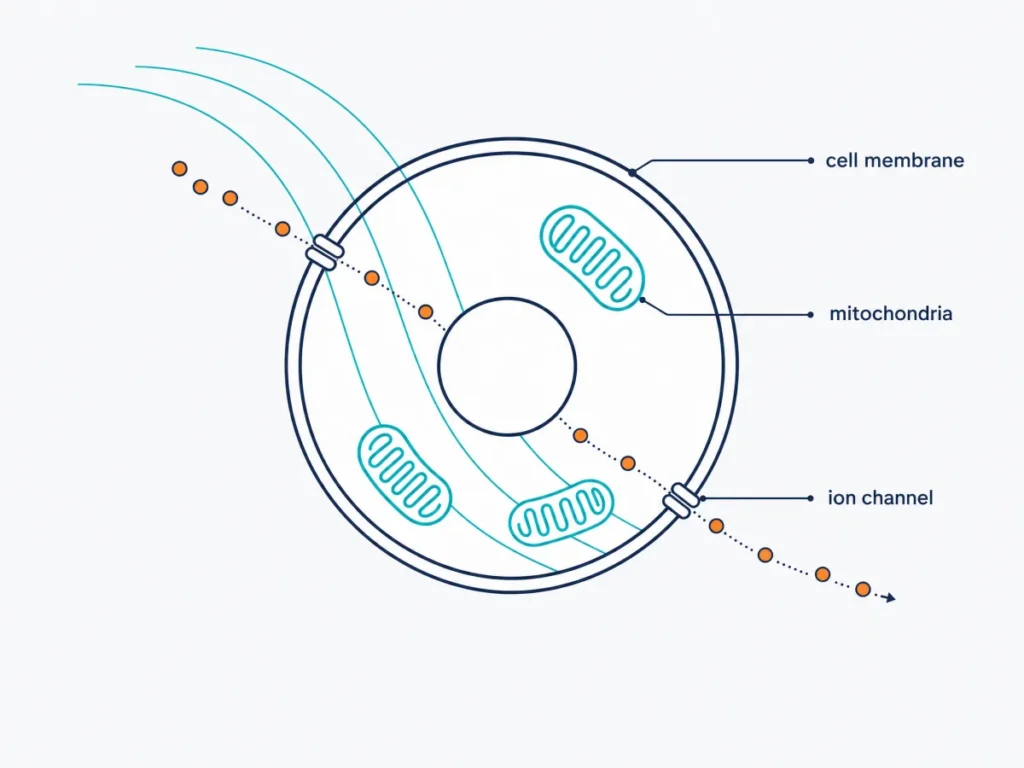
- Ion channels and the cell membrane. A leading proposed mechanism is that PEMF triggers the forced vibration of free ions on the surface of the plasma membrane, disrupting the electrochemical balance of transmembrane proteins — including voltage-gated ion channels — that regulate what enters and exits the cell.
- Calcium signaling. PEMF-induced changes at the membrane can increase or decrease intracellular calcium (Ca²⁺). Calcium is a central signaling molecule; the review notes that calcium release from voltage-gated calcium channels regulates immune responses and tissue repair.
- Cell signaling and gene expression. The review states that PEMF can modulate cell-surface receptors and downstream signal-transduction pathways, and that these effects can be “propagated and effectively amplified” along the signaling pathway, modifying cell behavior.
- ATP and cellular energy. The review notes that low-frequency or weak electromagnetic fields have been shown to alter adenosine triphosphate (ATP) synthesis — the molecule cells use for energy. It does not present a single ATP measurement as a headline finding, so it is more accurate to say ATP effects are reported in the literature than to claim a specific result.
- Anti-inflammatory signaling. In the laboratory experiments described, PEMF stabilized anti-inflammatory cytokines (such as IL-10) and reduced pro-inflammatory cytokines (such as IL-1β and IL-6) in activated cells — a pattern the authors describe as potentially relevant to inflammatory and regenerative processes.
The review is careful to call this an emerging treatment and a proof-of-concept study, and to note that the specific molecular mechanisms are “still under investigation.” PEMF outcomes depend on frequency, intensity, waveform, and exposure time, so a result from one device and protocol does not automatically transfer to another.
The NASA study: what it actually found
The most frequently cited piece of PEMF research is a 2003 NASA technical paper by Thomas J. Goodwin at the Johnson Space Center, titled Physiological and Molecular Genetic Effects of Time-Varying Electromagnetic Fields on Human Neuronal Cells ([NASA TP-2003-212054](https://ntrs.nasa.gov/citations/20030075722)). NASA’s interest was practical: astronauts lose tissue integrity in space, and the agency wanted to know whether a time-varying electromagnetic field could help grow and preserve neural tissue.
What the study found, using human neural progenitor cells in culture:
- Cells exposed to a time-varying electromagnetic field (TVEMF) proliferated at 2.5 to 4.0 times the rate of unexposed cells.
- Exposed cells organized into three-dimensional aggregates that emulated organized neural tissue, rather than just growing as a flat sheet.
- Gene-expression analysis showed changes across thousands of genes, with up-regulation of genes associated with growth and cellular proliferation and down-regulation of genes associated with the non-growth profile of mature cells.
Two things to keep straight about this study, because they are often blurred in marketing:
- It was a cell-culture study, not a clinical trial. Human cells in a laboratory dish, not human beings in a clinic. It is strong mechanistic evidence that electromagnetic fields do something real and organized to living tissue at the genetic level — it is not evidence that a consumer PEMF device treats any condition in a person.
- The parameters are specific. The study used low-amplitude, rapidly time-varying fields. A result obtained with one signal does not mean every PEMF device produces the same effect, because PEMF outcomes depend on frequency, intensity, waveform, and exposure time.
Schumann resonance and 7.83 Hz: what the claim is
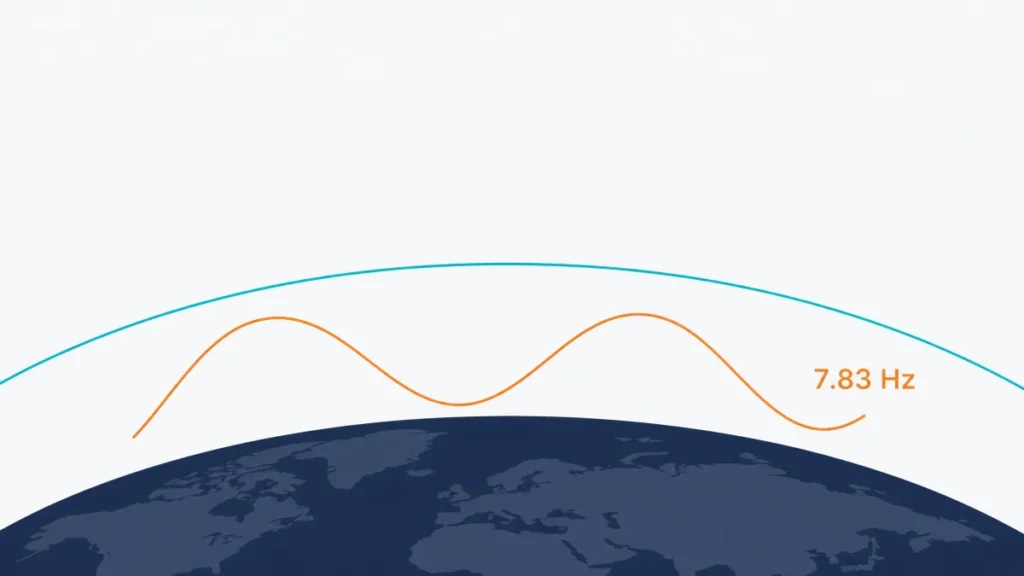
You will often see PEMF marketing mention the “Schumann resonance” at 7.83 Hz as the Earth’s natural electromagnetic frequency and claim that matching it makes PEMF more effective or more natural. The Schumann resonance is a real phenomenon — a set of low-frequency electromagnetic resonances in the Earth-ionosphere cavity, with a fundamental frequency around 7.83 Hz. But the strong marketing claim that PEMF devices must match 7.83 Hz to be effective or to be in tune with the body is not supported by the NASA study or the peer-reviewed mechanism review above.
Neither the Goodwin NASA paper nor the Ross review mentions the Schumann resonance or 7.83 Hz. The NASA study used fields in the low-Hz range; the Ross review describes experiments at 5.1 Hz and 15 Hz. So while 7.83 Hz is a real frequency and some devices use it, the claim that it is uniquely therapeutic or that the body requires it is a marketing framing, not an established scientific finding. Treat it with appropriate caution.
What PEMF is being studied for


The Ross review discusses PEMF research in the context of inflammatory and immune conditions (including rheumatoid arthritis, type 2 diabetes, and Crohn’s disease) and tissue regeneration (including bone, muscle, nerve, and wound healing). The authors frame PEMF as having potential in these areas, not as a proven treatment. The clearest and longest-established clinical use is bone healing — certain PEMF devices are FDA-cleared as adjunctive treatment for nonunion fractures, a use that goes back to the first clearance in 1979. For more on that, see our page on FDA clearance and PEMF.
None of this research supports using a consumer PEMF device as a treatment for a serious medical condition in place of professional medical care. The cellular and animal studies are mechanistic evidence, not clinical proof that a home device treats a specific condition.
Why one study does not settle every question
PEMF research can look complicated because every study combines a biological question with a specific signal and a specific treatment protocol. You do not need to become an engineer to read it intelligently, but a few details matter before applying a study result to a device comparison:
| Detail | Why it matters |
|---|---|
| Field strength (intensity) | Describes the intensity of the magnetic field at a defined point. How it is measured and the distance from the applicator matter. |
| Frequency | How often the field cycles or pulses. It is only one part of a complete treatment protocol. |
| Waveform | The shape and timing of the pulses. Two products that list the same frequency can still deliver very different signals. |
| Exposure time | Studies may use minutes, hours, or repeated sessions over days or weeks. One short session does not automatically correspond to another protocol. |
Because of these variables, a result from a clinical or laboratory study with one device and protocol does not automatically transfer to a consumer device with different parameters. This is why responsible PEMF education separates what is established from what is still being studied.
What is established and what is still being studied?
To summarize the evidence picture honestly:
- Established: certain PEMF devices are FDA-cleared for specific, narrow medical uses — nonunion fractures, certain post-surgical pain, and certain spinal fusion support. This clearance applies to prescribed clinical devices, not consumer wellness products.
- Actively researched: the cellular mechanisms by which PEMF affects ion channels, calcium signaling, gene expression, and inflammatory pathways. The Ross review and the NASA study are part of this body of mechanistic research.
- Not established: that any consumer PEMF mat or portable device treats, cures, or prevents any medical condition. General wellness claims (sleep, relaxation, recovery, energy) are not FDA-cleared indications for any consumer device.
For the underlying research abstracts, see our collection of 79 peer-reviewed abstracts on the effects of magnetics on physical ailments, and our page on PEMF and the U.S. National Library of Medicine / NCBI.
Important: this is not medical advice
ElectroMeds is an independent PEMF device distributor, not a medical provider. Nothing on this page constitutes medical advice, diagnosis, or a treatment recommendation. The devices ElectroMeds sells are general wellness products, not FDA-cleared medical devices, and are not intended to treat, cure, or prevent any disease. If you have a medical condition — especially a serious one — consult a qualified healthcare provider before using any PEMF device. See our contraindications and PEMF safety pages.
A Null Result Worth Knowing About
Most pages that discuss PEMF report the studies that found an effect. This one is worth stating plainly because it used the same category of device sold for home use.
In a double-blind, randomized, placebo-controlled experiment, 70 healthy volunteers used either a commercially available whole-body PEMF mat or an identical sham while acute ischemic muscle pain was induced in the forearm. The researchers found no difference between the active and sham groups in pain threshold, pain tolerance, heart rate, or perceived reduction in pain. What did predict the reported effect was what participants expected the device to do.
The authors concluded that the device had no specific effect on acute ischemic muscle pain in this model, and that the placebo contribution was considerable.
One detail matters for interpreting it in either direction. The device ran at 2.05 Hz with a maximum flux density of 25.3 µT. That is a far lower intensity than the systems on this site, which reach into the tens of thousands of microtesla. So the study is the right device format at a very different dose, and it examined experimentally induced acute pain in healthy people rather than a clinical condition. It does not settle the question for higher-intensity systems, and it is not evidence that PEMF does nothing. It is evidence that a low-intensity mat did nothing measurable in this particular model, and that expectation is a real and measurable part of what people experience.
Böszörményi-Nagy G, et al. “No effect of a pulsed magnetic field on induced ischemic muscle pain. A double-blind, randomized, placebo-controlled trial.” Physiology & Behavior. 2018;184:55-59. PMID: 29127072. DOI: 10.1016/j.physbeh.2017.11.007
Anyone selling these devices has an interest in not mentioning a study like this. We would rather you weigh it.
Sources

- Ross CL, Zhou Y, McCall CE, Soker S, Criswell TL. “The Use of Pulsed Electromagnetic Field to Modulate Inflammation.” Bioelectricity, 2019. PubMed Central PMC8370292.
- Goodwin TJ. “Physiological and Molecular Genetic Effects of Time-Varying Electromagnetic Fields on Human Neuronal Cells.” NASA Technical Paper TP-2003-212054, September 2003. NASA Technical Reports Server.
Frequently asked questions about PEMF science
- Is PEMF scientifically proven to work?
- PEMF has a body of peer-reviewed research behind it, but “proven” is too strong a word for most uses. Certain applications are better studied than others. The strongest evidence is in bone-healing and specific clinical pain contexts. For general wellness and recovery uses, the evidence is promising but still emerging. Honest summary: there is real research, but it does not prove that every PEMF device delivers every claimed benefit.
- What did the NASA study actually find?
- A 2003 NASA contractor technical report (Thomas Goodwin, NASA TP-2003-212054) found that specific pulsed electromagnetic field parameters increased the proliferation rate of human neural progenitor cells in a cell-culture experiment by roughly 2.5 to 4 times. It is a laboratory cell-culture study, not a clinical trial on people, and it does not prove that a consumer wellness device produces any health benefit in a human body.
- Does PEMF have to match the Schumann resonance of 7.83 Hz?
- No. The Schumann resonance is a real natural electromagnetic phenomenon, but the claim that PEMF must match it to be effective is a marketing claim, not a finding supported by the NASA study or mainstream cellular research. PEMF effects depend on field strength, frequency, waveform, and treatment protocol, not on matching one specific natural frequency.
- Is PEMF FDA-approved?
- Specific PEMF devices are FDA-cleared for specific medical uses, mainly bone healing, spinal fusion support, and certain pain indications. The general wellness devices sold for home use are not FDA-cleared medical devices. See Is PEMF FDA-Approved? for the full distinction.
- Is PEMF the same as using static magnets?
- No. Static magnets produce a constant field. PEMF produces a pulsed, time-varying field that induces electrical currents in tissue. This is why PEMF is studied for biological effects in a way that static magnets generally are not.