
What Is PEMF: What Is Pulsed Electromagnetic Field Therapy?
Pulsed electromagnetic field therapy — often called PEMF therapy — uses electricity to create a changing field that turns on and off in a programmed pattern. A device delivers that field through a small applicator, a pad, a mat, or a larger system. Unlike a static magnet, a pulsed field changes over time, which is what allows it to induce tiny electrical currents in tissue.

The word “magnetic” can be confusing because it covers different things. A refrigerator magnet is a static magnet: its field does not change. A device that creates a pulsed field is an electromagnet: electricity produces a changing field in a coil. The National Center for Complementary and Integrative Health distinguishes these categories and reviews their evidence separately.

How does pulsed electromagnetic field therapy work?
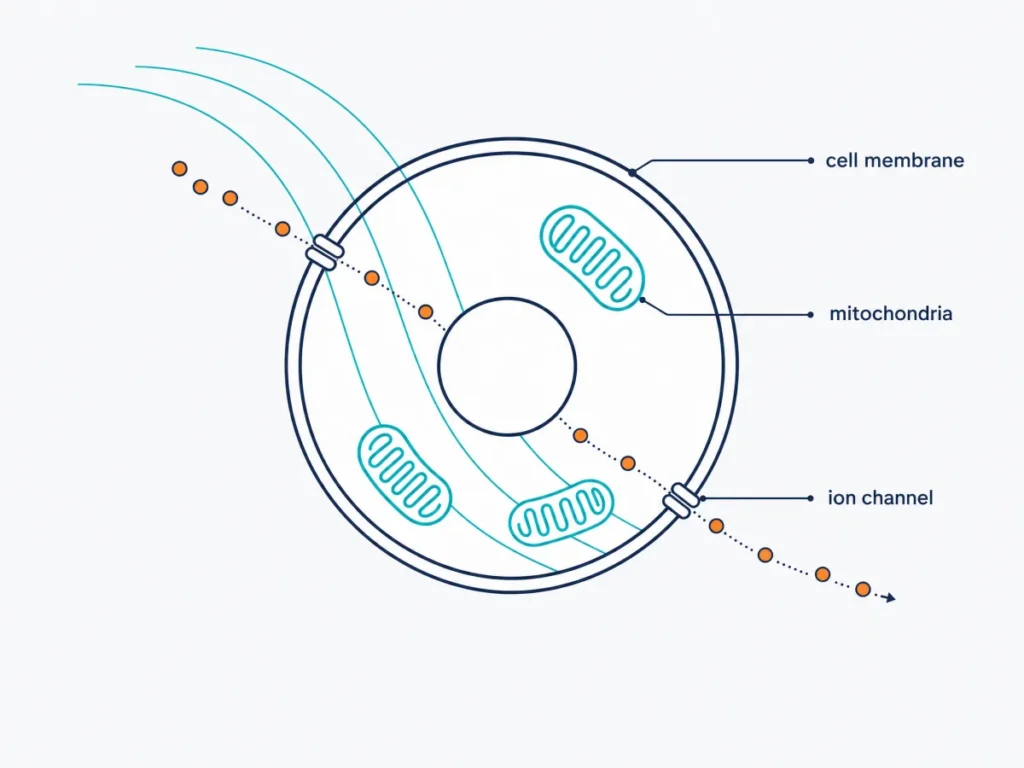
The basic physics. A device passes electrical current through a coil to produce a changing signal. When that field reaches the tissue, it can induce tiny electrical currents in the tissues beneath the applicator. This is the same principle that makes a transformer work — a changing signal in one coil induces a current in another conductor nearby. The difference is that in therapy, the tissues are the conductor. Most devices work by emitting low-frequency electromagnetic pulses that travel from the coil through clothing and skin into the underlying tissue, where an electric current is conducted naturally by the body’s own fluids and cells. Unlike a static magnet, which produces no change, the field turns on and off rapidly, and that changing waveform is what makes the therapy distinct from ordinary magnetic products.
Proposed mechanisms at the cell level
Researchers have proposed several mechanisms for why a pulsed field might matter biologically. These include supporting cell metabolism and adenosine triphosphate (ATP) production, influencing nitric oxide signaling and microcirculation, and affecting how cells respond to oxidative stress. Some published studies suggest that these fields may influence pathways, though the clinical significance of these effects remains under investigation. A 2023 review in the peer-reviewed literature summarizes several of these proposed mechanisms.
Natural fields and the Schumann resonance
The Earth itself produces a natural, low-frequency field — sometimes associated with the Schumann resonance of roughly 7.8 Hz — and some devices are designed to work in a similar low-frequency range. It is important to separate what is well established from what is still being investigated. The basic physics is not in dispute; what remains actively studied is which combinations of frequency, intensity, waveform, and application time produce a meaningful clinical effect for a given condition, and for whom.
NASA funded a multi-year study of these fields in the early 2000s, partly to understand potential applications for tissue repair and cell metabolism during spaceflight, and that work is frequently cited in marketing. The practical takeaway: this is a real, studied technology, but the claims that matter are specific to a device, its settings, and the condition in question. For more on the underlying science and how device parameters differ, see the science and education resources.
What makes one device different from another?
Frequency, intensity, and waveform
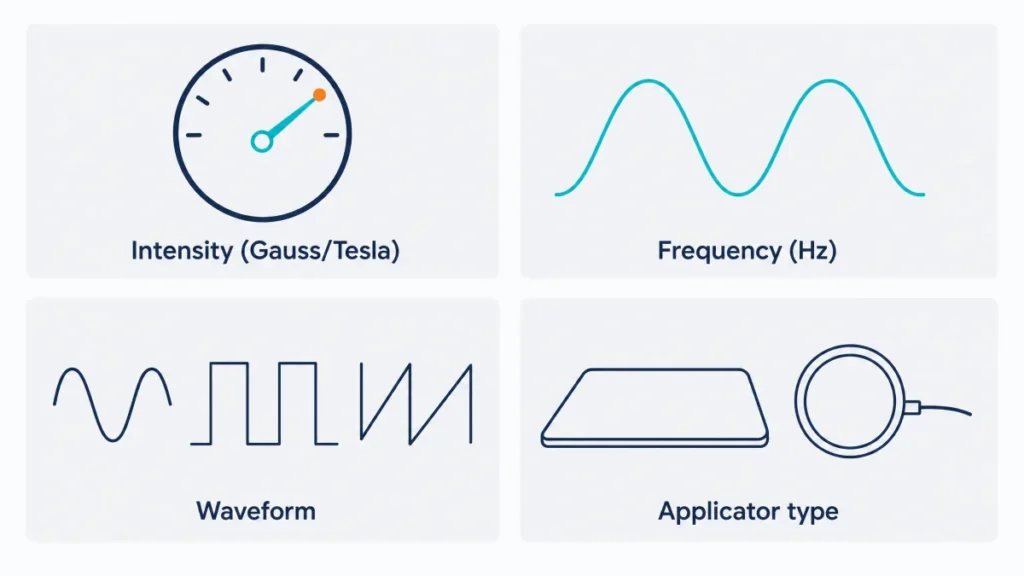
This is a category, not one standard treatment. A research protocol may specify a certain signal strength, frequency, waveform, application time, and placement. Change any of those details and you may be looking at a different exposure entirely. The 2023 review Pulsed Electromagnetic Fields (PEMF): Physiological Response and Its Potential in Trauma Treatment notes that differences in physical parameters and clinical outcomes make it difficult to generalize findings across the full research landscape. Read the review abstract on PubMed.
Applicator type and field delivery
That is why a good device comparison begins with practical questions: Where do you plan to use it? What area are you trying to reach? Do you need a portable applicator, a full-length mat, or a professional system? And what does the device manual say about intended use and precautions? A small coil applicator and a large full-body mat deliver the signal very differently — one concentrates the signal on a small area, the other spreads a lower-intensity signal across the whole area. Neither is inherently better; they serve different goals.
To understand why two devices and two research studies can look very different, read how settings and research methods differ, or compare the MultiPulse and StemPulse systems directly.
What has the therapy been studied for?
Orthopedic and fracture research. Researchers have investigated electromagnetic therapies in a number of settings, particularly in musculoskeletal and orthopedic applications. There are specific regulated uses for prescription devices, including fracture nonunions and certain postoperative pain and edema applications. Those facts do not mean that any over-the-counter device has the same intended use or that a result from one study applies to a different device. Device-specific labeling and a clinician’s advice matter.
For an honest overview, see the ElectroMeds research library. Each topic should be read as a starting point for investigation, not as a personal treatment recommendation.
Pain, inflammation, and cell-level repair studies. The strongest research evidence sits in a few orthopedic and pain-related areas. Devices have been cleared by the U.S. Food and Drug Administration for specific, device-labeled uses — not as a general-use claim — including certain bone-fracture (nonunion) and postoperative pain and edema applications. Researchers have also studied these fields for:
- Fracture healing and nonunions — among the most established applications, with FDA-cleared growth stimulators.
- Osteoarthritis, especially knee osteoarthritis, where some controlled studies report improvements in pain and function.
- Chronic low back pain and certain kinds of nerve discomfort.
- Post-surgical recovery and soft-tissue repair in some clinical settings.
- Fibromyalgia and fatigue associated with multiple sclerosis, though evidence is more limited.
How to read the clinical evidence correctly
It is important to read that list the right way. A condition appearing here means the therapy has been studied for it — not that an over-the-counter device is proven or approved to treat it. Most uses outside the FDA-cleared, device-specific ones lack strong, consistent evidence from blinded, placebo comparison studies. If you are considering a device for a specific condition, the question is not whether “PEMF” works in the abstract, but whether a specific device, at specific settings, has evidence for your situation. That is a conversation to have with a clinician who knows your history. Browse the research library to see the original topics, study designs, and limits of the findings.
Electromagnetic waves and safety. The electromagnetic waves produced by these devices are non-ionizing, meaning they do not carry enough energy to damage DNA the way X-rays do. That is an important distinction: a pulsed field is not radiation in the harmful sense, and the energy levels used in typical sessions are quite low. Still, non-ionizing does not mean zero risk for every person — the contraindications below explain who should avoid or modify use.
Cell-level effects and research
Some peer-reviewed studies have examined whether these fields may produce effects at the cell level. Inflammation is part of a natural repair response, but chronic inflammation is implicated in pain, joint degeneration, and delayed tissue repair. Published research on PubMed has explored whether induced fields can modulate markers and cell signaling pathways, though the clinical relevance of these laboratory findings is still being established. It is worth noting that a cellular or animal study result does not automatically translate to a human clinical outcome — that is why well-designed randomized, double-blind trials and systematic reviews carry more weight than isolated laboratory experiments. Researchers refer to these fields collectively as pulsed electromagnetic fields (PEMFs), and the broader category is sometimes described as electromagnetic therapy. Because the exposure is non-invasive and the device uses low-level pulses rather than a strong constant field, researchers have been able to study it as a non-invasive treatment in a range of clinical and wellness settings without surgery or medication.
Is the therapy FDA-cleared?
What “FDA-cleared” actually means. Partially, and only for specific devices and uses — not as a blanket category. The FDA first cleared these devices in November 1979 for growth stimulation. As of the most recent count, roughly three dozen devices are FDA-cleared, concentrated in three areas: fracture recovery (including certain nonunion fractures), spinal fusion support, and specific discomfort-management applications. These clearances are device-specific: they apply to a particular device, with a particular intended use, at particular parameters. A general-use mat is not the same as a prescription bone-growth stimulator, and its labeling cannot make the same claims.
How to verify a clearance claim
That distinction matters a lot for anyone reading marketing. “FDA-cleared” on a specific medical device is a real, verifiable claim about that device’s intended use. It does not transfer to every product on the market. If a seller implies that a clearance for one device covers their whole category, that is a red flag. You can verify device-specific clearances through the FDA product classification database and review a summary of FDA-cleared applications in the peer-reviewed literature. For a full plain-language explanation, see Is PEMF FDA-Approved? What FDA Clearance Actually Means.
What does a session feel like?
People’s experiences vary by device and settings. Some people notice little or no sensation. Others may feel a mild pulsing, tingling, or warmth, depending on the product and how it is used. Sensation alone does not prove that a device is or is not working. Follow the device instructions, begin conservatively when appropriate, and stop if you have an unexpected reaction. Session length commonly ranges from about 5 minutes to 30 minutes for at-home devices, and some sessions run longer.
Who should be cautious?
If you have a pacemaker, insulin pump, neurostimulator, cochlear implant, or another implanted electronic or medical device, ask the clinician who manages it before using a pulsed field device. People who are pregnant, managing a medical condition, or considering use for a child should also get individualized medical guidance. Do not use a general-purpose device to postpone treatment for symptoms that need medical evaluation. Read the full contraindications and safety guidance before considering a device.
Read safety and practical questionsLearn how settings differ
Who uses this therapy?
People come to pulsed field therapy from many different backgrounds and for many different reasons. Understanding who tends to use these devices — and why — can help you decide whether it fits your own routine and goals.
Home users managing everyday discomfort. Many people first hear about these devices from a chiropractor, physical therapist, or friend, and want a non-drug option they can use at home between visits. A portable applicator like the MultiPulse is often the starting point for targeted use on a shoulder, knee, or lower back. Others prefer a full-body mat for broader coverage during a relaxing evening session.
Practitioners and clinics. Chiropractors, physical therapists, sports-medicine practices, and some equine veterinarians incorporate these fields into their existing treatment. For these users, a professional-grade system with higher-intensity applicators and multiple coils is usually the right fit. If you are a practitioner comparing systems, the machines comparison lays out clinical and home models side by side, and the portable device guide covers compact options suitable for travel or multi-room use.
Athletes and active adults. Recovery is a common reason athletes explore these devices. Some use a session after training to support circulation and relaxation; others incorporate it into a broader recovery routine that includes stretching, sleep, and nutrition. The StemPulse wearable is popular with people who want a hands-free option during daily activity.
People researching their options. If you are still in the research phase, the most useful next step is to narrow down what you actually want the device to do. Are you looking for targeted relief in one area, complete relaxation, or a professional tool for a clinic? Do you need portability, or will the device stay in one room? The buyer’s guide walks through these questions in detail, and the mat vs. machine comparison helps you decide between a full-body mat and a focused applicator.
Whatever your background, the same principle applies: a pulsed field is a complementary tool, not a replacement for medical treatment. Pair it with guidance from a clinician who knows your history, and choose a device whose labeling, warranty, and support match how you actually plan to use it.
How does it compare to other therapies?
Pulsed fields vs. TENS. TENS delivers electrical current through pads on the skin to stimulate nerves, usually for temporary pain relief. A pulsed field uses an electromagnetic approach that can pass through clothing and tissue without skin contact, and works at a different level. They are not the same modality and the research behind each is separate. Read our comparison.
Compared with infrared and red light therapy
Infrared heat warms tissue from the surface and is often used for relaxation and circulation; red light therapy targets specific wavelengths. Some mats combine a pulsed field with infrared heat in one product, but the mechanisms are distinct. Other options people consider alongside or instead include acupuncture, massage, biofeedback, and conventional physical therapy. This is best understood as a complementary approach, not a replacement for medical treatment or a standalone treatment for disease.
A brief history of the technology
From laboratory curiosity to clinical devices
The idea that a changing field could influence living tissue originated more than a century ago, but the modern form of this therapy took shape in the 1970s. Researchers were looking for a non-invasive way to support fracture repair, particularly in fractures that had failed to heal on their own. In 1979 the FDA cleared the first device for bone-growth stimulation, an event that shaped how the category is regulated today.
Why the research grew slowly. One reason the evidence base has taken decades to build is that no two studies use exactly the same parameters. A study published on PubMed might use one frequency and intensity, while another uses different settings entirely, making direct comparison difficult. Systematic reviews therefore tend to be cautious: they note that some signals exist — particularly for fracture repair, pain, and inflammatory markers — but call for larger, well-designed controlled studies before drawing firm clinical conclusions.
What does it cost?
Price ranges by device type. Home devices span a wide price range. Entry-level portable applicators may cost a few hundred dollars, full-body mats commonly run from about $1,000 to $5,000, and professional clinical systems can cost considerably more. The price reflects the coil size, the number of applicators, the available frequency and intensity range, and the build quality. Price does not always correlate with effectiveness for a given goal — a well-suited mid-range device used correctly may serve a home user better than a premium system used poorly.
Financing and pre-owned options. Because the upfront cost can be significant, many dealers offer financing, and pre-owned certified devices can lower the barrier to entry. If you are comparing systems, the price guide lays out current models and ranges side by side. Warranty, return policy, and access to a real person who can answer questions matter as much as the sticker price, especially for a device you will use regularly over months and years.
What to expect with regular use
Consistency and realistic timelines
Unlike a medication with a predictable onset, the experience of using a device is more gradual and individual. Some people report noticing changes in how they feel over days or weeks of consistent use, while others use the device as part of a broader recovery routine without tracking a specific before-and-after. The research literature generally frames these interventions as something that may support recovery and comfort rather than produce an immediate, dramatic change.
Working with a clinician
If you are managing a specific condition — chronic pain, post-surgical recovery, a fracture concern, or ongoing inflammation — the most useful step is to talk with a clinician who knows your history. They can help you decide whether a device makes sense alongside your current treatment, which settings or device type might suit your situation, and how to set realistic expectations. This page is an educational overview, not a treatment plan; your individual circumstances should guide any decision.
How to choose a device
Because this is a broad category rather than one standard treatment, choosing a device starts with practical questions rather than a single “best” brand:
- Where and how will you use it? A portable applicator for targeted use, a full-length mat, or a professional clinical system each serve different needs.
- What area are you trying to reach? Localized applicators and full-body mats differ in field strength, coverage, and intended use.
- What does the manufacturer’s labeling say? Intended use, precautions, and any clearance claims are device-specific — read them.
- What is your budget? Home devices range from a few hundred dollars to several thousand; professional systems cost considerably more. Financing and pre-owned options can help.
- What support comes with it? Warranty, return policy, and real human support matter, especially for a device you will use regularly.
If you are new to this, our guide to choosing a device for home use walks through these questions in detail, and the machines comparison lays out current systems and price ranges side by side. For a deeper look at the MultiPulse portable system, see the MultiPulse product page; for the entry-level wearable, see the StemPulse product page.
Frequently asked questions
- Is pulsed field therapy safe?
- For most healthy adults, it is generally well tolerated when used as directed with a quality device. However, it is not appropriate for everyone — see the contraindications below. People with implanted electronic medical devices, who are pregnant, or who have a medical condition should get individualized guidance from a clinician before use.
- Is it the same as a static magnet?
- No. A static magnet (like a refrigerator magnet) produces a field that does not change. A pulsed field device uses an electromagnet to create a field that pulses on and off in a programmed pattern, which is what allows it to induce currents in tissue. The NCCIH overview treats these as separate categories.
- Does it treat or cure diseases?
- No over-the-counter device is approved to treat or cure a disease. Specific prescription devices are FDA-cleared for particular, labeled uses (such as certain nonunion fractures and postoperative pain). General wellness devices are not a treatment for any disease and should not be used to postpone medical treatment. This is best understood as a complementary approach.
- How long is a session?
- Session length depends on the device, settings, and intended use. Sessions commonly range from about 5 minutes to 30 minutes for at-home devices, and some run longer. Follow the device manual and start conservatively.
- Will I feel it working?
- Not necessarily. Some people feel a mild pulsing, tingling, or warmth; others notice little or no sensation. Sensation alone does not indicate whether a device is or is not effective for your goals.
- Is it covered by insurance?
- Often not. Insurance coverage varies, and many at-home devices are not covered. FDA-cleared prescription devices used under medical supervision may be handled differently. Check with your insurer and clinician.
Sources
For a full explanation of what “FDA-cleared” means, which specific uses have cleared devices, and how to verify a claim yourself, see Is PEMF FDA-Approved? What FDA Clearance Actually Means.