
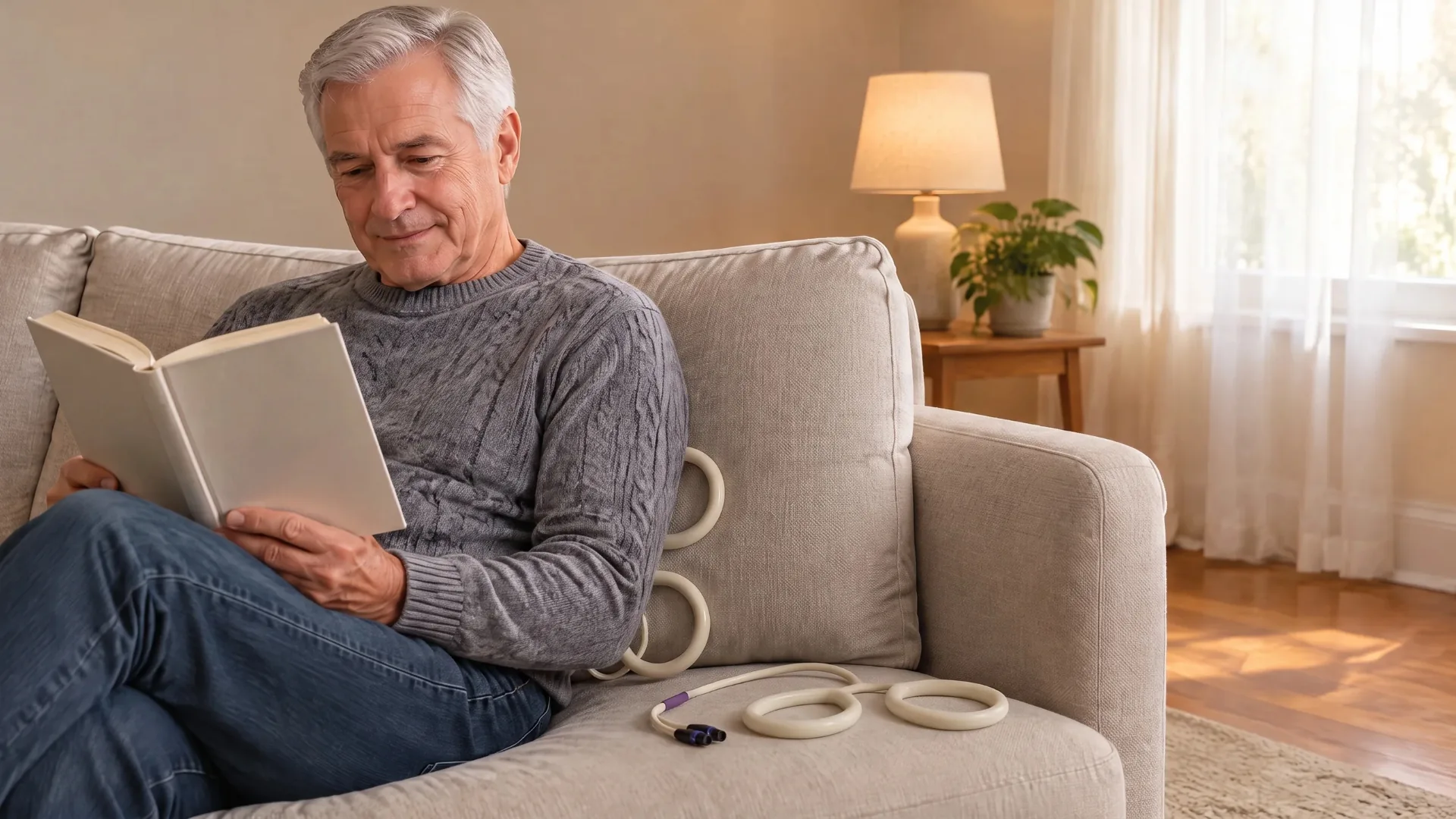
In August of 2021 I sold a MegaPulse 2.0 with a butterfly loop applicator to a grandfather in New Jersey. He was buying it for his teenage granddaughter — but by the time the sale closed, he was buying it for himself too.
She had been diagnosed with Legg-Calvé-Perthes disease — a condition where the blood supply to the ball of the hip is disrupted, the bone begins to die, and the hip joint slowly deforms. It is painful. It is progressive. And in a growing child it can permanently reshape the joint in ways that make early hip replacement — sometimes in the twenties or thirties — a near certainty.
The family had been to the doctors. They had heard the proposal.
The plan the family was handed
The medical protocol on offer was this: surgically break both of her hips, then immobilize her in a body cast for approximately six months while the bones healed in the new position.
Six months. A teenage girl. Body cast. No walking. No school in the normal way. No swimming, no friends, no bike, no ordinary anything. Six months of being lifted, cleaned, and turned by other people, in the middle of the years that are supposed to shape a life.
The grandfather was not willing to accept that as the only answer. So the family went looking.
What they found
They found a clinic somewhere in their region — I don’t remember the exact town — that had a high-powered PEMF device available for rental sessions. They brought her in. She had a session. She felt better.
The problem was the two weeks between rentals. The relief was real, but the gaps were breaking the progress. Every time she came back she had lost ground.
Then, on one of those rental days, the grandfather sat down on the machine himself.
The other reason he bought the machine
Here is the part of the story I skipped over.
Many years before any of this, the grandfather had been in a serious motorcycle accident that essentially destroyed his back. The reconstruction was extensive — he and his surgeon spent so much time together during the repairs and the recovery that they ended up close friends. Best buddies, the way he told it to me. That gives you a sense of how much rebuilding was involved and over how many years.
The surgeons put him back together. But rebuilt is not the same as unbroken. He lived with real, daily chronic back pain — the kind you carry with you into every ordinary hour of the day.
So when he sat down on that clinic PEMF machine and ran a session on his own back, he was not experimenting on a whim. He was a man who knew exactly what his back felt like every day for years, being handed a tool he had never tried before. He got up, felt the difference, and made the decision on the spot.
The next day he called me and bought a MegaPulse 2.0 with a butterfly loop applicator. Two people were going to use it. His granddaughter would use it in the evenings and on weekends for her hips. And during the day, while she was at school, he was going to run sessions on his own back.
What happened next
A few years later he called me again — the way long-term owners sometimes do, just to talk.
He told me his granddaughter was living a completely normal high school life. She had joined the swim team. She was doing her homework sitting on the couch with the butterfly loops draped across her hips.
He also told me he had been using the machine on his own back nearly every day since the day he bought it — daytime sessions, while she was at school. He loved the difference it made. Not “cured his back” — the back was rebuilt hardware and there’s no undoing a motorcycle accident — but a real, felt, daily difference in how much of himself he had available for the rest of his life.
That’s the whole story. No body cast. No surgical break. A teenager on the swim team, doing her homework with a PEMF applicator on her lap the way another kid might sit with a heating pad. And a grandfather who had bought a machine for her, who ended up using it every day for himself.
Why this story matters, beyond one family
Perthes disease is rare, and I am not going to pretend that every family gets the outcome this one did. Individual results vary — that phrase exists for a reason, and it applies here.
But there are two things about this story that are worth thinking about even if your situation is nothing like theirs.
The first is that the standard-of-care answer is not always the only answer. When the medical profession hands a family a plan that involves months of a teenage girl’s life being taken from her, it is reasonable — it is right — for that family to look for a second path. Sometimes there is one. Sometimes it involves technology that is well-established in Europe and in FDA-cleared use in the United States but is not the first thing your specialist mentions.
The second is that the alternative here isn’t hypothetical or fringe. PEMF (pulsed electromagnetic field therapy) has been studied for decades. Specific devices carry FDA clearances for post-operative pain and edema, for non-union fracture healing, and for use as an adjunct in cervical spine fusion. The mechanism — improved microcirculation to compromised tissue, restored ATP production, reduced inflammation — is exactly what a hip with a disrupted blood supply needs.
None of that means PEMF is a treatment for Perthes disease. It is not, and I am not selling it as one. What this family did was use a serious PEMF device, at home, on their own schedule, as part of a broader care plan for a child whose blood supply to the hip needed help. The outcome speaks for itself.
What might have happened without it
I don’t know for certain what would have happened if this family had accepted the surgical plan on offer. Neither do they. There is no counterfactual you can run on a human life.
What I can tell you is that pediatric Perthes patients whose hips deform badly during growth often face early total hip replacement — sometimes in their twenties, sometimes in their thirties, sometimes with a second replacement to follow in middle age. The joint never quite recovers its normal geometry, and the wear pattern that follows is unforgiving.
This young woman, as of the last time her grandfather called me, was on the swim team.
The machine he bought, and what I would suggest today
He bought a MegaPulse 2.0 with a butterfly loop applicator. In today’s catalog that same machine is the MegaPulse T2 Mobile PEMF Device — the “2.0” was the earlier product name for the 2-Tesla mobile unit; the current name reflects the T2 (2 Tesla) hardware. It is a high-intensity portable PEMF device with a focused applicator that can be placed directly over a specific area — a hip, a spine segment, an ankle, a shoulder — while the person sits or lies comfortably.
In this family’s case, the same machine served two people with completely different conditions: a teenager with a pediatric hip disease and an older adult with post-traumatic chronic back pain. That is the practical reality of a good PEMF device in a household — it earns its place many times over, for many people, for many reasons.
If your situation calls for whole-body coverage rather than a focused high-intensity applicator — for example, chronic full-body inflammation, sleep and circulation support, or an elderly household member who wants a mat rather than a targeted loop — the Sedona Pro PEMF Mat is the other system I would put in front of you.
If you are reading this because someone in your family is facing a similar decision, or because you have a chronic joint or bone-related condition of your own, I would say: don’t shop from a page. Call me. Every family situation is different, and the right PEMF device for a growing teenager with a hip condition is not the same as the right device for a 70-year-old with arthritis or a post-surgical knee. I sell several systems and I have used all of them personally. I would rather spend twenty minutes on the phone with you and help you figure out what actually fits than sell you the wrong machine.
If you want to talk
Call 442-444-0050, or write to info@electromeds.com. I answer personally. No sales script, no automated funnel, no pressure. If PEMF isn’t right for your situation I will tell you so.
— Russ Guillemot, owner, ElectroMeds
This is a customer story told to me, based on my firsthand sales experience with the family and a follow-up call a couple of years later; names are withheld to protect the granddaughter’s privacy. Individual results vary. PEMF is not a treatment for Legg-Calvé-Perthes disease and no claim of cure or specific outcome is made or implied. This story is not medical advice. Always work with your pediatric orthopedist or specialist when making decisions about a child’s care. Specific PEMF devices sold by ElectroMeds are FDA-cleared for defined medical indications — see each product page for details. ElectroMeds sells PEMF devices for wellness and general well-being; statements on this page have not been evaluated by the FDA. Always consult your physician before starting any therapy, particularly if you are pregnant, have a pacemaker or implanted electronic device, have active cancer, or are being treated for a serious medical condition.