
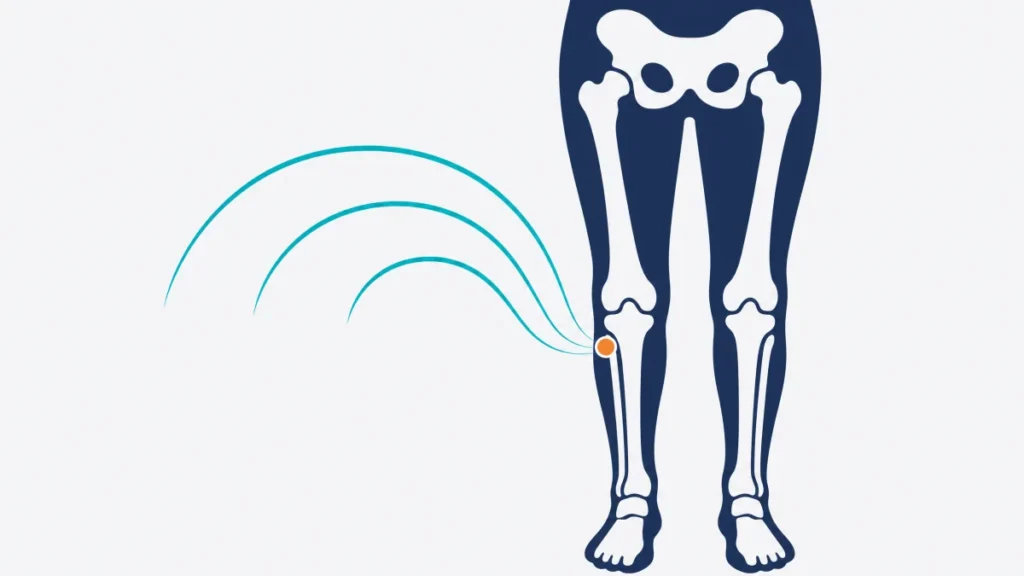
Femoral-head osteonecrosis, also called avascular necrosis, is loss of blood supply to part of the ball of the hip joint. Research on pulsed electromagnetic fields, or PEMF, has focused on whether this type of stimulation might be part of early-stage joint-preservation research before substantial collapse, not on general hip pain.
What researchers have studied
Researchers have studied PEMF and other forms of electrical or electromagnetic stimulation in adults with osteonecrosis of the femoral head. The practical question has usually been whether an early-stage femoral head can remain structurally intact for longer, sometimes alongside established joint-preservation procedures such as core decompression and bone grafting. Studies have used several staging systems, including Ficat, Steinberg, and ARCO. In broad terms, earlier stages identify disease before or near the beginning of structural collapse, while later stages include more advanced loss of the spherical femoral-head shape.
The published work is not a single, uniform treatment program. Some cohorts used external coils for several hours a day over months. Some studied stimulation with surgery, and one later comparison evaluated an implanted induction system after curettage and bone grafting. Researchers have measured pain and hip-function scores, plain radiographs and magnetic resonance imaging, radiographic progression, femoral-head collapse, and later total hip arthroplasty. These are different outcomes. A change in a pain score, for example, does not itself establish that collapse was avoided or that joint replacement will not be needed.
This page is about femoral-head osteonecrosis and early-stage joint preservation. Arthritis is a different condition; see PEMF and Arthritis: What the Research Shows.
The studies
Al-Jabri and colleagues, 2017
Al-Jabri and colleagues conducted a systematic review of electrical stimulation for adult avascular necrosis of the femoral head. Their search identified 46 records and included 10 clinical studies, eight prospective and two retrospective. The review reported that results tended to be more favorable in early Ficat stages, with reported clinical and imaging improvements in PEMF studies. The authors concluded that PEMF may have a role in early disease but emphasized the small number of clinical studies.
This review is useful for seeing the breadth of the literature, but it did not pool results in a meta-analysis. The included studies differed in stage, stimulation protocol, follow-up, outcome definitions, and whether surgery or grafting was also used. Its findings therefore describe a limited and heterogeneous evidence base rather than a settled estimate of benefit.
Full citation: Al-Jabri T, Tan JYQ, Tong GY, Shenoy R, Kayani B, Parratt T, Khan T. The role of electrical stimulation in the management of avascular necrosis of the femoral head in adults: a systematic review. BMC Musculoskeletal Disorders. 2017;18:319. PMID: 28754159. DOI: 10.1186/s12891-017-1663-5.
Aaron and colleagues, 1989
Aaron and colleagues prospectively compared external PEMF with core decompression in 106 hips with Ficat stage II or III osteonecrosis. In the review’s extraction of the study, 52% of hips in the PEMF group and 20% in the core-decompression group met the study’s combined clinical and radiographic success definition at a mean three-year follow-up. The review also reported clinical success in 68% and 44% of hips, respectively. This is a direct comparison that remains important because few studies have compared these approaches.
The comparison does not provide a modern randomized trial of a single intervention. The publication predates current trial-reporting expectations, and the systematic review describes limited detail on baseline outcomes and no numerical pain scores in its table. Stage distribution, lesion size and location, underlying cause, and treatment selection can all affect outcomes. The results should not be read as establishing a general replacement for specialist-directed core decompression.
Full citation: Aaron RK, Lennox D, Bunce GE, Ebert T. The conservative treatment of osteonecrosis of the femoral head. A comparison of core decompression and pulsing electromagnetic fields. Clinical Orthopaedics and Related Research. 1989;(249):209-218. PMID: 2582669.
Massari and colleagues, 2006
Massari and colleagues retrospectively reviewed 76 hips in 66 people with Ficat stage I, II, or III femoral-head osteonecrosis. Participants used PEMF for eight hours daily for an average of five months. The researchers designated avoidance of hip surgery as the primary endpoint and radiographic stage progression as a secondary endpoint. At final follow-up, the authors reported that 15 hips required total hip arthroplasty, 12 of them in people whose hips were stage III when treatment began. They reported preservation of 94% of the stage I or II hips and radiographic progression in 26% of all hips.
The stage pattern is notable, but this was a retrospective Level IV study without a concurrent comparison group. A favorable outcome in early-stage hips may reflect earlier disease, lesion characteristics, underlying causes, other management, or natural variation as well as the study intervention. The paper does not establish how the results would compare with observation, surgery, or another stimulation protocol.
Full citation: Massari L, Fini M, Cadossi R, Setti S, Traina GC. Biophysical stimulation with pulsed electromagnetic fields in osteonecrosis of the femoral head. Journal of Bone and Joint Surgery American. 2006;88 Suppl 3:56-60. PMID: 17079368. DOI: 10.2106/JBJS.F.00536.
Bassett and colleagues, 1989
Bassett and colleagues reported a clinical series of 118 hips in 95 people treated with selected PEMF protocols. Most hips already had collapse when they entered the program. At a mean 5.3 years of follow-up, the researchers reported no progression among 15 hips in Steinberg stages 0 through III, while 18 of 79 stage IV hips progressed and no stage IV hip improved. Across the series, the authors reported 16% quantified progression and described symptom changes and surgical procedures.
This was a clinical series, not a randomized controlled comparison. The study included a broad mix of causes and disease severity, and most hips had already collapsed. Its results are better read as stage-stratified observations from an older protocol than as proof of a predictable outcome. In particular, the small number of early-stage hips limits precision for the group most relevant to joint preservation.
Full citation: Bassett CA, Schink-Ascani M, Lewis SM. Effects of pulsed electromagnetic fields on Steinberg ratings of femoral head osteonecrosis. Clinical Orthopaedics and Related Research. 1989;(246):172-185. PMID: 2670386.
Windisch and colleagues, 2014
Windisch and colleagues conducted a prospective, nonrandomized cohort study in 35 people with nontraumatic femoral-head osteonecrosis. Nineteen participants received curettage, autologous bone grafting, and invasive electromagnetic stimulation using an implanted bipolar induction screw. Sixteen received the same curettage and grafting procedure without the stimulation system. At 12 months, four patients in each group had undergone total hip arthroplasty. Both groups improved on pain and hip-function measures, and the researchers found no significant between-group differences.
This comparison is valuable because it tested an adjunct against a surgical control group. It is also narrow: the stimulation was invasive, the assignment was nonrandomized, the sample was small, and follow-up was only 12 months. It cannot answer whether an external PEMF format would have the same results, nor can it isolate long-term effects on collapse or arthroplasty.
Full citation: Windisch C, Kolb W, Röhner E, Wagner M, Roth A, Matziolis G, Wagner A. Invasive electromagnetic field treatment in osteonecrosis of the femoral head: a prospective cohort study. Open Orthopaedics Journal. 2014;8:125-129. PMID: 24987486. DOI: 10.2174/1874325020140515001.
How strong is this evidence?
The evidence is limited. The 2017 systematic review found only 10 eligible clinical studies across electrical stimulation methods, and their designs, populations, stimulation parameters, and follow-up periods were too heterogeneous for a meaningful pooled estimate. Randomized evidence specific to external PEMF in femoral-head osteonecrosis is scarce. Several frequently cited reports are retrospective series, older prospective comparisons, or studies in which treatment assignment was not randomized. That makes it difficult to separate an intervention’s contribution from selection of patients, natural history, activity modification, medications, or other care.
Stage sensitivity matters. Across the reports, apparent results were generally more favorable in Ficat or ARCO early-stage hips than in hips with established collapse. That pattern is clinically plausible for a joint-preservation question, but it is not the same as a validated rule for an individual. Stage labels are not the whole picture. Lesion size, location, underlying cause, whether an exposure such as corticosteroid use continues, and imaging findings can influence prognosis and treatment planning.
Co-interventions are another major limitation. In the Windisch comparison, invasive electromagnetic stimulation was studied alongside curettage and autologous bone grafting, with the comparison group receiving the same surgery without the stimulation system. Results from that setting cannot be translated directly to external PEMF used without surgery. When both groups receive surgery, any improvement in symptoms or imaging cannot automatically be attributed to the added stimulation. Conversely, a lack of difference in a small surgical comparison may not rule out every protocol or patient subgroup.
Finally, outcomes should not be collapsed into one claim. Pain and function are patient-important outcomes. MRI or radiographic findings provide different information. Femoral-head collapse is a structural endpoint, and later arthroplasty is a further endpoint shaped by symptoms, imaging, patient circumstances, and clinical judgment. A study can report a symptom change without demonstrating less collapse, or a short imaging follow-up without showing fewer later replacements. These distinctions are essential when interpreting early-stage research.
What this means if you are considering a PEMF device
The research does not provide a one-size-fits-all home-use protocol for a hip osteonecrosis diagnosis. The studies used particular coil placements, signal parameters, schedules, and clinical follow-up arrangements. Some used external formats for long daily sessions, while another used an implanted system as an adjunct to surgery. Comparing these study formats is not evidence of equivalence or a recommendation.
A hip osteonecrosis diagnosis needs specialist assessment, including staging and imaging review. A person considering any PEMF device should not use it in place of clinical management, monitoring, or discussion of joint-preservation options. The key decision is not simply whether a study reported improvement. It is whether the study population, disease stage, format, co-interventions, outcome, and follow-up have any reasonable relevance to the person’s own clinical situation.
For neutral background on terminology and research interpretation, see PEMF education and PEMF science. Neither background resource substitutes for an orthopedic assessment of possible femoral-head osteonecrosis.
Questions to ask before buying
- Ask whether a clinician has confirmed femoral-head osteonecrosis and reviewed the stage, lesion size, location, and imaging findings with you.
- Ask what the realistic goals are for your stage, including symptom monitoring, repeat imaging, preserving the femoral head, and the possibility of later surgery.
- Compare the study format with the format under consideration, including placement, schedule, follow-up, and whether the research used surgery or another co-intervention.
- Ask how you would know if the condition is progressing and which clinician will review new or worsening symptoms and imaging.
- Review practical safety information, contraindications, return terms, warranty, total cost, and the time commitment before making a purchase.
This page summarizes published research for reference. It is not medical advice, and nothing here is a claim that any PEMF device treats, cures, or prevents any condition. PEMF is not appropriate for everyone — review PEMF contraindications and talk with your own physician before beginning any new therapy, particularly if you have an implanted electronic device, are pregnant, or are being treated for a serious medical condition.