
iMRS 2000 Reviewed
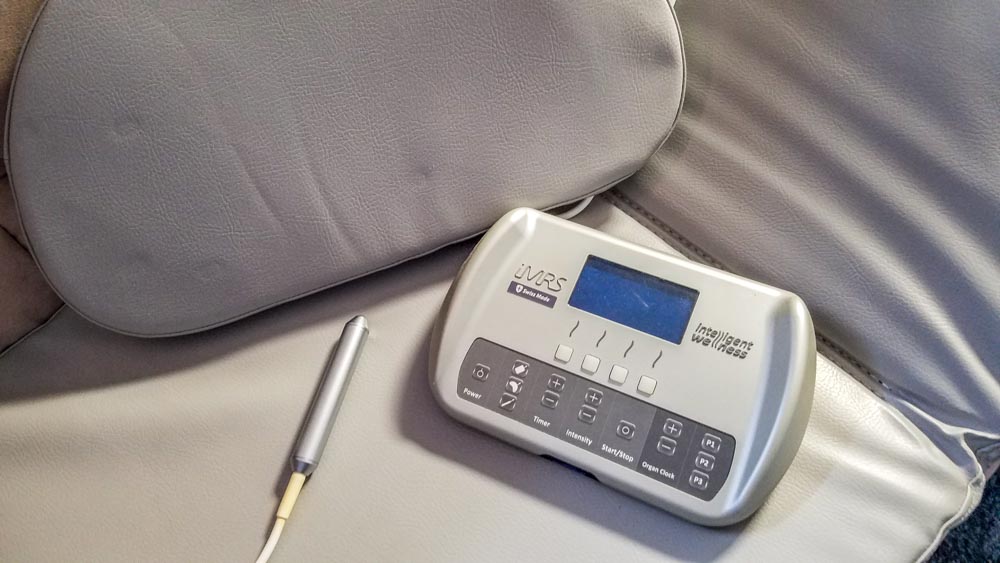
The iMRS 2000 has been around for many years. Made in Germany, it’s a well-engineered PEMF device with a wide range of features. Like many PEMF products, the marketing around it is heavy and it helps to filter through it with straight facts about frequency, waveform, intensity, and design choices.
At ElectroMeds we evaluate PEMF devices on four fundamentals: frequency, waveform, intensity, and ease of use. These four factors determine how a device delivers a magnetic signal and how comfortable it is to run day after day. A device that scores well across all four generally provides more flexibility for a home or clinic user.
Earth frequencies vs iMRS frequencies
Research by Adey, Zimmerman, and others indicates that the frequency range the human body most readily absorbs is roughly 0–30 Hz. Adey coined the term “biological window” for this range.
The iMRS 2000 operates between 0.5 and 15 Hz (with higher harmonic frequencies in a sawtooth waveform on the pillow mat). This sits comfortably inside the biological window — a design choice similar in principle to the Bemer, though the two devices differ significantly in signal geometry. Adey and Zimmerman describe cellular interaction in this range as being sensitive to the leading edge of the pulse; iMRS uses that fact by delivering many pulses per second on its accessory pad and probe.
One design choice worth noting: the sawtooth waveform is used on the full body mat, while the accessory pad and probe use a square wave. Sawtooth waves have sharper leading edges that many designers use for cellular excitation. Arguably, that assignment would make more sense reversed — the pad and probe are typically used for short targeted sessions (10–15 minutes), while the full body mat is often used for longer sessions or overnight, where a gentler waveform may be preferred.
Intensity and polarity
The iMRS 2000 operates between 0.09 and 70 microtesla (µT). Earth’s magnetic-field intensity ranges from 33 µT at the equator to about 66 µT at the poles — so the iMRS covers earth-intensity range well. Low intensity is not a weakness: many long-term studies use very low field strengths and report positive outcomes.
The iMRS also switches polarity every two minutes. This helps prevent the body from acclimatizing to a static signal orientation, which is a real consideration on devices where the same signal runs unchanged for long sessions.
Setup, session length, and reliability
The iMRS 2000 is straightforward to set up and its controls are simple. Session length is capped at 24 minutes, which some users find restrictive. Full body mats on this class of device can be fragile at the seams over time; the unit we tested had some issues, though iMRS support was responsive.
Overall, the iMRS 2000 is a legitimate PEMF device with sensible frequency selection and a good polarity feature. At its historical price point (typically $4,000+), we would want to see more waveform choices and higher-intensity applicators as standard.
Buying the iMRS 2000 today
iMRS 2000 is distributed through a multi-level marketing sales network, which is a significant part of the price. If you’re comfortable with that model and want the iMRS specifically, buy it through the official channel. ElectroMeds does not carry iMRS.
If you’re evaluating the iMRS 2000 against other options, we generally recommend looking at Sedona Pro for a full-body mat with a broader waveform library and adjustable session length, or the MegaPulse series for high-intensity work that goes well beyond earth-intensity range. Both are direct-distributed (no MLM tier), which is why the price-per-spec is lower.
If you already own an iMRS 2000 and it works for you, keep using it. It is a well-engineered device inside the biological window.
iMRS 2000 technical details
- iMRS 2000 Pro Package
- Full Mat (Sawtooth waveform)
- Pillow Mat (Sawtooth waveform)
- Probe attachment (Square wave)
- Goggles and headset for relaxation
- HRV ear attachment
- Carrying case included
- Frequency – 0.5–15 Hz + harmonics
- Intensity – 0.09–70 µT (Earth intensity = 33–66 µT)
- Graduated Intensity – 3× stronger at feet, weaker at head
- Biorhythm – 15 Hz, 5.5 Hz, 3 Hz, 0.5 Hz
- Waveform – Sawtooth on full body mat, square wave on pad and probe
- Polarity – switches every two minutes
- Sound and Light frequencies – Synchronized with mat
- Distribution – Multi-level marketing (not through ElectroMeds)
What we carry today instead
ElectroMeds specializes in direct-distributed PEMF devices at what we believe is honest per-spec pricing. See our complete PEMF catalog, or contact us at 442-444-0050 for a scoped comparison against a specific need.
ElectroMeds does not carry pre-owned iMRS 2000 devices. If you’re looking for a used unit, try eBay, Craigslist, or PEMF-owner forums — those are the honest places to find one.
These statements have not been evaluated by the FDA. PEMF devices sold by ElectroMeds are FDA-cleared for their intended uses. This page is for informational purposes only and does not diagnose, treat, cure, or prevent any disease.