
The studies summarized here evaluated prescription bone growth stimulators prescribed and monitored by orthopedic clinicians, which are a different regulated category from general-wellness PEMF systems. ElectroMeds general-wellness PEMF systems are not equivalent to those clinical devices and are not FDA-cleared for bone healing.
What researchers have studied
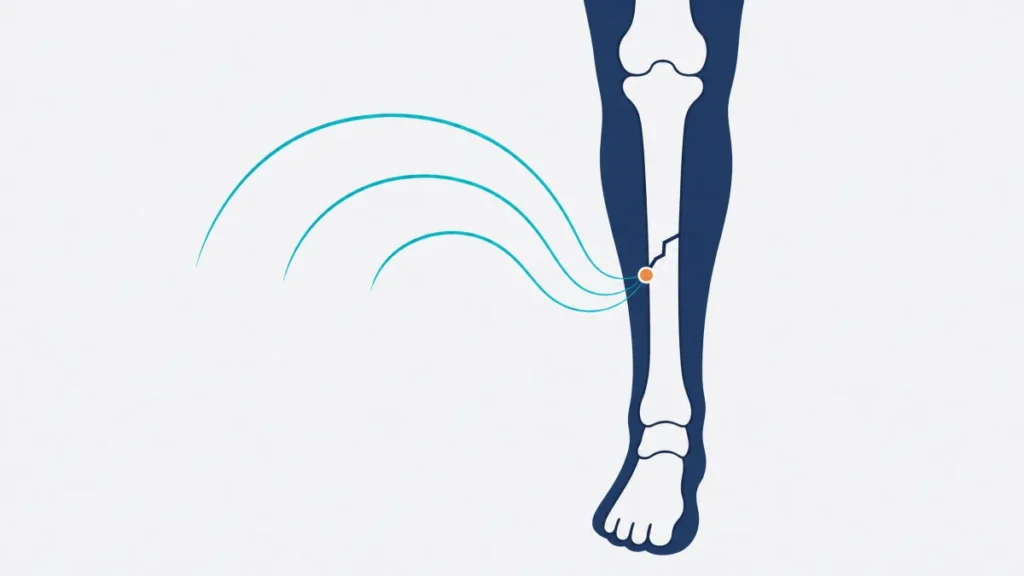
Researchers have examined electromagnetic or electrical stimulation in several separate settings: a fresh fracture, a fracture that is healing more slowly than expected, an established nonunion, an osteotomy, and spinal fusion. Those are not interchangeable clinical questions. This page concentrates on long-bone fractures and delayed union or nonunion, while noting when a review combined other diagnoses or device types. The published literature includes pulsed electromagnetic fields, capacitive coupling, and direct-current approaches. Some reviews pool these approaches, so their results cannot automatically be read as results for PEMF alone.
A nonunion is not simply a fracture that feels slow to improve. It is a diagnosis made in context, using the injury history, examination, serial imaging, stability, alignment, infection risk, and other clinical factors. Studies also use different definitions of union and assess it at different times. That variation matters when one analysis reports an early signal and another does not find a difference at a later follow-up.
Bone density and fracture healing are distinct questions. Information about bone density, fracture risk, and osteoporosis belongs in our osteoporosis overview, not in the fracture-healing evidence summarized here. The studies below concern clinician-managed orthopedic care, not self-directed wellness use.
The studies
Griffin and colleagues’ Cochrane review of delayed union and nonunion
Griffin and colleagues reviewed blinded, randomized, placebo-controlled trials in adults with delayed union or nonunion of long bones. Their review included four trials with 125 participants, most involving tibial nonunion. Three trials evaluated pulsed electromagnetic fields and one evaluated capacitive coupling, so the review did not evaluate one uniform intervention.
The reviewers found that the pooled proportion of fractures united at the reported time point was not statistically significant. The estimate remained non-significant in a 24-week sensitivity analysis. Two trials did not show less pain, and none reported functional outcomes. This review is directly relevant to the question of established long-bone healing problems, but the small trials had important limitations and substantial heterogeneity. The authors concluded that the evidence was inconclusive and insufficient to guide practice.
Griffin XL, Costa ML, Parsons N, Smith N. Electromagnetic field stimulation for treating delayed union or non-union of long bone fractures in adults. Cochrane Database Syst Rev. 2011;(4):CD008471. PMID: 21491410. DOI: 10.1002/14651858.CD008471.pub2.
Ebrahim and colleagues’ time-specific network meta-analysis
Ebrahim and colleagues analyzed randomized trials of electrical stimulation and low-intensity pulsed ultrasound for fresh fractures and existing delayed union or nonunion. Fifteen of 27 eligible trials contributed data. For delayed union or nonunion, their comparison of electrical stimulation with standard care suggested a possible higher union rate at three months, but the confidence interval crossed no difference. The estimates at six and twelve months were not statistically significant.
This pattern is important because it does not establish a durable benefit from an early result. The researchers rated the relevant evidence very low quality, citing risk of bias, indirectness, and imprecision. Their electrical-stimulation category was broader than PEMF and the network approach included indirect comparisons. The review therefore supplies a careful description of uncertainty, not a basis for substituting a general-wellness system for orthopedic evaluation.
Ebrahim S, Mollon B, Bance S, Busse JW, Bhandari M. Low-intensity pulsed ultrasonography versus electrical stimulation for fracture healing: a systematic review and network meta-analysis. Can J Surg. 2014;57(3):E105-E118. PMID: 24869616. DOI: 10.1503/cjs.010113.
Hannemann and colleagues’ review of acute fractures
Hannemann and colleagues reviewed 13 randomized trials involving 737 adults with acute fractures. They pooled studies of PEMF and low-intensity pulsed ultrasound, rather than reporting PEMF as a standalone evidence set. Their pooled analysis of the proportion of nonunions found no significant difference between the active approaches and control.
The researchers described heterogeneous findings for time to radiological union. Some analyses favored the active approaches in non-operatively managed fractures or upper-limb fractures, and another suggested faster clinical union in acute diaphyseal fractures. Those observations concern acute fracture care, not a diagnosed long-bone nonunion. Pooling two technologies and several fracture settings limits how specifically the results can be applied. The review itself concluded that randomized evidence was insufficient to conclude a reduction in nonunion incidence for acute fractures.
Hannemann PFW, Mommers EHH, Schots JPM, Brink PRG, Poeze M. The effects of low-intensity pulsed ultrasound and pulsed electromagnetic fields bone growth stimulation in acute fractures: a systematic review and meta-analysis of randomized controlled trials. Arch Orthop Trauma Surg. 2014;134(8):1093-1106. PMID: 24895156. DOI: 10.1007/s00402-014-2014-8.
Aleem and colleagues’ sham-controlled meta-analysis
Aleem and colleagues combined 15 randomized sham-controlled trials with 1,247 participants. The trials covered fresh fractures, delayed union or nonunion, osteotomy, and spinal fusion, and included PEMF, capacitive coupling, and direct-current stimulation. At the last reported follow-up, up to twelve months, their pooled analysis estimated fewer radiographic nonunions or persistent nonunions. In two trials reporting function, the analysis did not find a statistically significant difference.
The breadth of this review is useful but also a limit. Its radiographic outcome was a surrogate, the indications and stimulation approaches differed, and the authors rated the radiographic evidence down for indirectness. Their sensitivity analysis lost statistical significance under a more unfavorable assumption about missing outcomes. The paper supports continued research and careful clinical interpretation; it does not show that every device category, fracture type, or individual receives the same result.
Aleem IS, Aleem I, Evaniew N, Busse JW, Yaszemski M, Agarwal A, Einhorn T, Bhandari M. Efficacy of Electrical Stimulators for Bone Healing: A Meta-Analysis of Randomized Sham-Controlled Trials. Sci Rep. 2016;6:31724. PMID: 27539550. DOI: 10.1038/srep31724.
Adie and colleagues’ acute tibial-shaft trial
Adie and colleagues conducted a multicenter, double-blind randomized trial in 259 people with acute tibial-shaft fractures. Participants received externally identical active or inactive devices, were instructed to use them for ten hours each day for twelve weeks, and otherwise continued usual fracture management. The primary outcome was a secondary surgical intervention for delayed union or nonunion within twelve months.
The trial did not find a between-group difference in that primary outcome. It also did not find differences in radiographic union, other surgery, or patient-reported functional measures. Eighty-four percent completed twelve-month follow-up, while average reported daily use was 6.2 hours, below the requested schedule. This is a relatively large, blinded trial, but it examined prevention of complications after an acute fracture rather than management after an orthopedic clinician has diagnosed nonunion.
Adie S, Harris IA, Naylor JM, Rae H, Dao A, Yong S, Ying V. Pulsed electromagnetic field stimulation for acute tibial shaft fractures: a multicenter, double-blind, randomized trial. J Bone Joint Surg Am. 2011;93(17):1569-1576. PMID: 21915570. DOI: 10.2106/JBJS.J.00869.
Shi and colleagues’ postoperative delayed-union trial
Shi and colleagues prospectively randomized 58 people with postoperative delayed union of long-bone fractures, diagnosed between 16 weeks and six months after surgery, to an active or sham protocol. Clinical and radiographic assessments occurred at three-month intervals. At the first three-month assessment, the active group had a higher union rate, but the difference was not statistically significant. By the study end, the authors reported higher union in the active group.
This small study is relevant because it enrolled people already identified as having delayed union and used a sham comparison. It does not settle the question on its own. The average protocol duration differed modestly between groups, the final assessment occurred after a mean of about 4.8 months of the active protocol, and the report cannot replace the larger mixed evidence base. Its setting was postoperative orthopedic follow-up, not unsupervised use after a suspected healing problem.
Shi HF, Xiong J, Chen YX, Wang JF, Qiu XS, Wang YH, Qiu Y. Early application of pulsed electromagnetic field in the treatment of postoperative delayed union of long-bone fractures: a prospective randomized controlled study. BMC Musculoskelet Disord. 2013;14:35. PMID: 23331333. DOI: 10.1186/1471-2474-14-35.
How strong is this evidence?
The evidence is mixed and time-dependent. Ebrahim and colleagues described a borderline, non-significant signal around three months for delayed union or nonunion that was not sustained as a statistically significant result at six or twelve months. Hannemann and colleagues found no significant difference in the proportion of nonunions in their pooled acute-fracture analysis. Griffin and colleagues likewise found no statistically significant pooled union result for the smaller delayed-union and nonunion trials. These results should not be resolved in favor of the technology.
There are also findings in the other direction. Aleem and colleagues’ broader sham-controlled synthesis estimated fewer radiographic nonunions or persistent nonunions at follow-up, while Shi and colleagues reported a higher final union rate in a small postoperative delayed-union trial. The difference among review results has understandable sources: populations ranged from fresh fractures to established nonunion; reviews combined different electrical approaches, and sometimes spinal fusion or osteotomy; definitions and imaging assessments of union differed; and follow-up was not uniform.
Radiographs matter, but they are not the whole experience of recovery. Functional outcomes were sparsely reported, and Aleem and colleagues found no clear functional difference in the two trials that provided such data. Blinding, adherence, missing data, small samples, and indirect comparisons further affect confidence. Overall, this is an area of clinician-managed research with some encouraging observations and important uncertainty, rather than a settled answer for a person with a fracture that may not be uniting.
What this means if you are considering a PEMF device
The studies described here used prescription bone growth stimulators prescribed and monitored by orthopedic clinicians, a different regulated category from general-wellness PEMF systems. ElectroMeds general-wellness systems are not equivalent to prescription bone-growth stimulators and are not a replacement for the clinical process used in these studies. For context about FDA clearance, see the linked overview.
A suspected delayed union or nonunion requires orthopedic diagnosis, imaging, and clinical management. A general-wellness device must not replace that evaluation or the care plan developed from it. Clinicians may need to assess fracture stability, alignment, infection, blood supply, medication and health factors, and whether surgery or another intervention is needed. Even when a prescription device is considered, its use belongs within that clinician-led plan and its follow-up. This page does not establish a personal indication, timing, or protocol for any device.
Questions to ask before buying
- Ask the orthopedic clinician managing the fracture whether current imaging and examination have established the diagnosis and next steps.
- Clarify which outcome the clinical plan will follow, such as imaging, pain, function, fracture stability, or a decision about further intervention.
- Ask who will review follow-up imaging and when changes in symptoms, swelling, fever, numbness, or function require prompt clinical contact.
- Read the intended-use statement for any device and distinguish a general-wellness description from a clinician-directed prescription indication.
- Keep the cost and time required for a device separate from the cost and time required for necessary orthopedic appointments, imaging, and rehabilitation.
This page summarizes published research for reference. It is not medical advice, and nothing here is a claim that any PEMF device treats, cures, or prevents any condition. PEMF is not appropriate for everyone — review PEMF contraindications and talk with your own physician before beginning any new therapy, particularly if you have an implanted electronic device, are pregnant, or are being treated for a serious medical condition.