
This page summarizes published research on pulsed electromagnetic fields (PEMF) for tendonitis and tendinopathy. It does not state what a PEMF device will do for a reader with either condition.
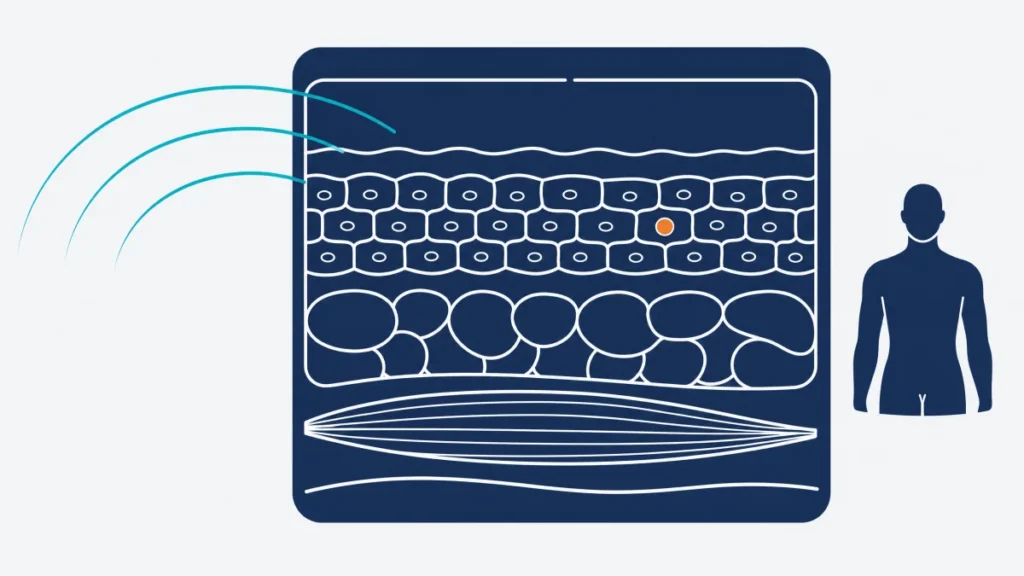
PEMF Tendonitis: What researchers have studied
Tendonitis is often used for tendon pain thought to involve inflammation. Tendinopathy is a broader term for persistent tendon symptoms and tissue change. The studies below do not treat those terms as one uniform diagnosis. They involve persistent rotator-cuff tendonitis, Achilles tendinopathy, surgical rotator-cuff repair, and experimental tendon injury. Those are different clinical and biological settings.
The human literature is small. It includes an older placebo-controlled trial in persistent rotator-cuff tendonitis, a randomized postoperative rotator-cuff study, and a recent Achilles trial conducted alongside eccentric exercise. A 2026 systematic review also gathered four randomized foot-and-ankle soft-tissue trials. Its evidence base was not limited to tendon disorders, and most trials tested PEMF as an addition to another conservative intervention.
Animal experiments add information about measured tendon tissue properties after an induced injury or surgical repair. They cannot answer what happens in people with an overuse-related tendinopathy. Lateral epicondylitis, often called tennis elbow, is a specific elbow condition with its own evidence discussion. For that narrower topic, see the dedicated tennis elbow research page.
The studies
Chia et al. 2026 systematic review
Chia and colleagues reviewed four randomized controlled trials, involving 243 people, on foot-and-ankle soft-tissue conditions. The diagnoses included Achilles tendinopathy, calcaneal spurs, and ankle sprain. Three trials reported a statistically significant between-group pain finding, but only one of three that assessed physical function reported a statistically significant between-group result. In three trials, PEMF was added to another conservative intervention; only one compared PEMF with sham stimulation.
This is the highest-level synthesis in this page, but it is not a review of tendinopathy alone. The diagnoses, PEMF parameters, comparison treatments, and outcome measures differed substantially. Its findings therefore cannot be treated as a single result for all tendon sites or as evidence about a particular device.
Chia CSM, Fu SC, Ko VMC, Lai JWH, Zhou M, Yung PSH, Ling SKK. “The Effects of Pulsed Electromagnetic Field Therapy on Pain and Physical Functions in Patients with Soft Tissue Injuries: A Systematic Review of Randomised Controlled Trials.” Frontiers in Sports and Active Living. 2026;8:1694944. PMID: 41716305. DOI: 10.3389/fspor.2026.1694944.
Binder et al. 1984 persistent rotator-cuff tendonitis trial
Binder and colleagues ran a double-blind, randomized controlled trial in 29 people with persistent rotator-cuff tendonitis whose symptoms had not responded to steroid injection and other conservative measures. Fifteen participants received PEMF and 14 received placebo during the first four weeks. The authors reported a statistically significant between-group benefit during that placebo-controlled phase. During the next four weeks, both groups received active coils, and the groups did not differ significantly. The lack of a group difference continued through an eight-week phase with no treatment.
The trial was small, dated, and limited to a selected shoulder population. Its later phases also make the early contrast hard to extend to longer-term outcomes. It does not establish findings for Achilles, patellar, elbow, or other tendinopathies.
Binder A, Parr G, Hazleman B, Fitton-Jackson S. “Pulsed Electromagnetic Field Therapy of Persistent Rotator Cuff Tendinitis: A Double-Blind Controlled Assessment.” Lancet. 1984;1(8379):695-698. PMID: 6143039. DOI: 10.1016/S0140-6736(84)92219-0.
Osti, Del Buono, and Maffulli 2015 after rotator-cuff repair
This randomized controlled study assigned 66 people after arthroscopic repair of small to medium rotator-cuff tears to PEMF or placebo. All participants followed the same postoperative rehabilitation program. At three months, the investigators reported statistically significant between-group differences in pain scores, range of motion, and two shoulder function scales. At the final follow-up, which was at least two years, the study reported no statistically significant between-group differences in clinical or functional outcomes.
This was a postoperative tear-repair population, not people with nonoperative tendonitis or tendinopathy. The early finding and later null result should be read together. The article does not establish whether its results apply to an unoperated, overuse-related tendon condition or to a different field system.
Osti L, Del Buono A, Maffulli N. “Pulsed Electromagnetic Fields After Rotator Cuff Repair: A Randomized, Controlled Study.” Orthopedics. 2015;38(3):e223-e228. PMID: 25760511. DOI: 10.3928/01477447-20150305-61.
Ko et al. 2026 Achilles tendinopathy trial
Ko and colleagues randomly assigned 65 participants with Achilles tendinopathy to active PEMF or sham PEMF, with both groups completing the same eccentric-exercise program. Thirty-four participants completed every follow-up through week 26. Function, two pain ratings, and quality-of-life scores improved over time within both analyzed groups. The reported group-by-time tests did not find statistically significant between-group differences for function, either pain rating, or quality of life.
Loss to follow-up reduced the analyzed sample from 65 to 34. Eccentric exercise was delivered to both groups, and the study cannot separate improvement associated with time and exercise from the added field component. It also concerns Achilles tendinopathy only, not tendon symptoms at other sites.
Ko VMC, Fu SC, Yung PSH, Ling SKK. “Randomised Control Trial on the Sustained Carry-Over Effects of Pulsed Electromagnetic Field Therapy for the Treatment of Achilles Tendinopathy.” Scientific Reports. 2026;16(1):7567. PMID: 41651914. DOI: 10.1038/s41598-026-38596-3.
Tucker et al. 2017 rat rotator-cuff repair model
This animal study randomized 70 rats to surgical rotator-cuff repair with PEMF, surgical repair without PEMF, or an uninjured control group. At four and eight weeks, the PEMF group had higher measured tendon modulus; maximum stress was higher at four weeks. The researchers found no significant group differences in gait or passive shoulder-joint mechanics. They also found no group difference in tendon stiffness or maximum load at the reported time points.
An acute, surgically repaired rat tendon is different from a human tendon with chronic overuse symptoms. The exposure was systemic, and the outcomes were laboratory mechanical and tissue measures rather than patient-reported symptoms. These findings cannot determine outcomes for people with tendonitis or tendinopathy.
Tucker JJ, Cirone JM, Morris TR, Nuss CA, Huegel J, Waldorff EI, Zhang N, Ryaby JT, Soslowsky LJ. “Pulsed Electromagnetic Field Therapy Improves Tendon-to-Bone Healing in a Rat Rotator Cuff Repair Model.” Journal of Orthopaedic Research. 2017;35(4):902-909. PMID: 27282093. DOI: 10.1002/jor.23333.
Lee et al. 1997 experimental Achilles tendonitis in rats
This animal study randomized 180 rats with experimentally injured Achilles tendons to two pulsed magnetic-field settings, two PEMF settings, or sham. At day three, the 46-Hz PEMF group had higher tendon water content than the other groups; by day seven it was similar to the other groups. By the end of the experiment, the 15-Hz PEMF group did not differ significantly from control. All groups had nearly normal collagen-fiber alignment by the end; the more favorable alignment reported by the authors was for a pulsed magnetic-field group, not a PEMF group.
The study mixed pulsed magnetic-field and PEMF conditions, measured experimental injury in rats, and did not study human symptoms or function. Its mixed and frequency-specific findings should not be generalized to human tendinopathy or to another device format.
Lee EW, Maffulli N, Li CK, Chan KM. “Pulsed Magnetic and Electromagnetic Fields in Experimental Achilles Tendonitis in the Rat: A Prospective Randomized Study.” Archives of Physical Medicine and Rehabilitation. 1997;78(4):399-404. PMID: 9111460. DOI: 10.1016/S0003-9993(97)90232-X.
How strong is this evidence?
The evidence specific to tendonitis and tendinopathy is limited and mixed. The systematic review is useful because it searched across randomized trials, but it included only four studies with different diagnoses. Three trials combined PEMF with another intervention. That makes it difficult to attribute a between-group difference, where one was reported, to the field component alone. The review also found inconsistent physical-function findings.
The direct human studies do not form a replicated evidence set for one diagnosis. Binder et al. enrolled 29 people with persistent rotator-cuff tendonitis and reported an early difference, followed by later phases without a significant group difference. Ko et al. used sham control and the same exercise program in both groups, but its analyzed sample was 34 after attrition and no group-by-time outcome reached statistical significance. Osti et al. involved surgical repair rather than ordinary tendinopathy and found an early contrast that was not present at final follow-up.
Animal studies are useful for asking whether particular laboratory measures differ after a controlled tendon injury or repair. They are not clinical studies. The rat models involved acute injury, surgery, different exposure arrangements, and outcomes such as tendon modulus, water content, gait, and histology. Together, these limitations mean the literature supports careful reporting of named studies rather than a general conclusion about a person, tendon site, PEMF system, or device.
What this means if you are considering a PEMF device
Start by separating the condition described in a study from the condition named in a product description. A postoperative rotator-cuff tear, persistent shoulder tendonitis, and Achilles tendinopathy are not interchangeable. Also separate the study equipment, field parameters, and co-interventions from a retail device. A portable applicator for a localized tendon area is a format comparison only. It is not evidence of equivalence to study equipment or a recommendation. For format context only, see portable PEMF machines.
A useful product comparison asks what is documented, not what is implied. Look for written information on the applicator, output specifications, controls, included components, warranty, return terms, and contraindication information. Research summaries should identify the actual diagnosis, comparison group, and follow-up period rather than treating any tendon-related study as interchangeable evidence.
Questions to ask before buying
- Does the seller provide field specifications and applicator dimensions in writing?
- Which exact study population is being cited, and was it a tendon condition or postoperative repair?
- What accessories, power options, controls, and documentation are included with the unit?
- What are the written return window, warranty, repair process, and possible restocking fees?
- Can the seller provide the contraindications and product manual before purchase?
This page summarizes published research for reference. It is not medical advice, and nothing here is a claim that any PEMF device treats, cures, or prevents any condition. PEMF is not appropriate for everyone — review PEMF contraindications and talk with your own physician before beginning any new therapy, particularly if you have an implanted electronic device, are pregnant, or are being treated for a serious medical condition.