
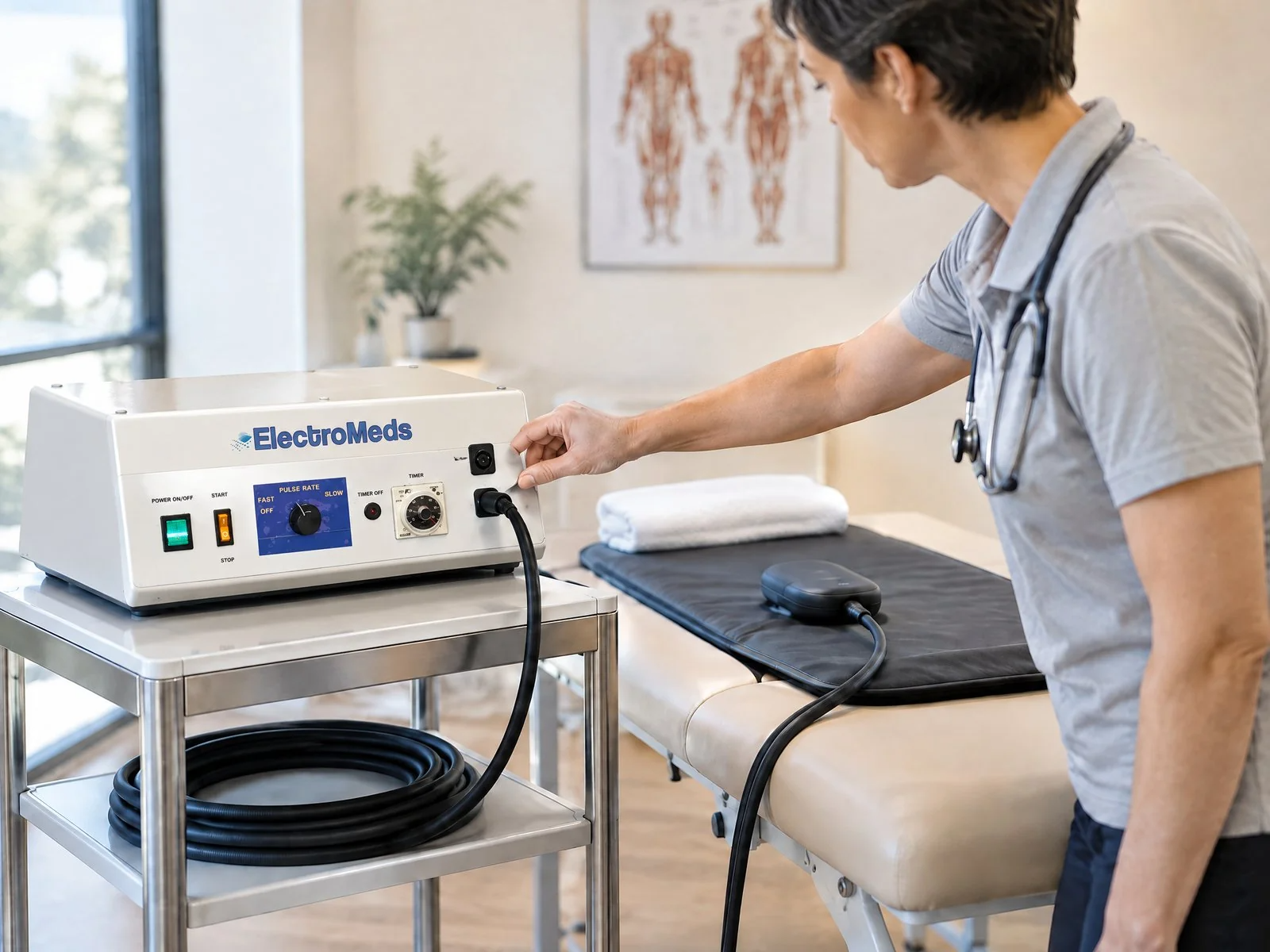
Comparing professional PEMF equipment for a chiropractic office, wellness practice, or mobile business? Start with the equipment, operating requirements, and support your practice needs, then compare the documented specifications of each system.
Searching for clinical grade PEMF? Use that phrase as a starting point for equipment comparison, not as a certification. ElectroMeds sells new MegaPulse systems; request a configuration quote for your practice and verify the exact model’s intended use and documentation.
This guide compares professional PEMF equipment from MegaPulse, MagnaWave, Pulse Centers, and DrPawluk TeslaFit. ElectroMeds sells MegaPulse, so this is a dealer’s buying guide, not an independent product test.
If you are researching a high-intensity PEMF unit or high output PEMF equipment, use the comparison below alongside the professional PEMF buying checklist. For the MegaPulse range, shop new high-output PEMF systems; for a rolling-case model, review the MegaPulse T2 Mobile.
Which Equipment Fits Your Practice?
When you search for professional PEMF equipment, turn that broad category into a specific equipment brief. Will the machine remain in a treatment room, move between offices, or travel with your practice? Which applicators, setup requirements, and support arrangements will fit that setting?
In this buying guide, clinical and professional describe the purchasing context, not a regulatory certification. Check each model’s documented intended use before adding it to your shortlist. Human-use equipment and animal-use equipment should not be treated as interchangeable.
Comparing High-Intensity and High-Output PEMF Technology
For a high-output PEMF unit, request the model and applicator behind the published field-output figure, along with the measurement location, settings, and test method. Compare those details side by side before drawing conclusions from a Gauss or Tesla number.
Keep three questions separate: what output the supplier documents, how the equipment operates, and what evidence supports the proposed use. Ask for pulse duration, waveform, repetition rate, and any energy specification separately instead of treating the field-output figure as a complete description of the system.
For a busy practice, compare session controls, setup and cleaning instructions, applicator changes, and manufacturer limits on consecutive operation. Confirm these requirements for the exact configuration rather than assuming that every professional unit has the same duty cycle.
Check Device Status and Intended Use
Ask for device-specific documentation when regulatory status matters to your purchase. FDA registration or listing does not establish approval or clearance; the FDA explains how to check a device’s status. Do not use a supplier’s category label as a substitute for that check.
Pulsed Electromagnetic Equipment: Build Your Shortlist
Use this table to compare configurations and identify the documents to request. It is not a ranking of treatment outcomes, and the listed systems should not be assumed to have equivalent intended uses or comparable output measurements.
| System | Starting point for comparison | Before ordering |
|---|---|---|
| MegaPulse T2 Mobile | Rolling-case option in the MegaPulse range. | Confirm current output documentation, supplied applicator, power requirements, and transport instructions. |
| MegaPulse SuperPro 2.0 | An alternative MegaPulse configuration to discuss alongside T2 Mobile. | Confirm case format, included equipment, applicator compatibility, and differences from T2 Mobile. |
| MagnaWave Sol Pro | The supplier describes an analog system with 12 intensity settings and animal-practice positioning. | Verify intended use, package, operating requirements, and the conditions behind its output specification. |
| MagnaWave Julian | Listed in MagnaWave’s analog PEMF range. | Request the current Julian documentation and compare its intended use and configuration with your equipment brief. |
| DrPawluk TeslaFit Pro Desktop Bundle | The current listing includes a desktop control unit, mat, loop coils, and paddle. | Confirm exact bundle contents, applicator-specific measurements, operating instructions, and written support terms. |
| Pulse XL Pro | The supplier presents it as a customizable system for home or office use with room-to-room mobility. | Request the current controls, accessory options, price, output documentation, and operating limits for your intended setup. |
Supplier descriptions are starting points for due diligence, not independent performance tests. Request a current written quote for each exact package, including optional accessories, delivery, taxes, service, and return terms. Use the professional PEMF buying checklist to keep each quote comparable.
MagnaWave: Compare the Exact Model and Intended Use
The Sol Pro supplier page describes an analog PEMF system with 12 intensity settings and a timer of up to 90 minutes. Its listed applications emphasize performance animals, livestock, and show or breeding operations. Buyers planning services for people should obtain the exact model’s human-use documentation rather than assuming that animal-practice positioning establishes that suitability.
MagnaWave lists Julian separately within its analog machine range. Ask for the current model sheet and package list before comparing portability, controls, output, warranty, or training. Do not substitute one MagnaWave model’s specifications for another’s.
ElectroMeds does not sell used PEMF equipment. Review the used PEMF buying guide before considering a second-hand purchase.
Pulse XL Pro: Controls and Accessory Configuration
The Pulse XL Pro supplier page emphasizes customization, accessory capability, and room-to-room movement. It positions the system for home or office use; confirm the exact controls and supplied accessories in the current model documentation.
Compare those practical requirements with the other professional PEMF equipment on your shortlist. Ask how the controls are used and what operating limits apply to the quoted configuration. Request a written price and model-specific output documentation instead of assigning a value ranking from an incomplete specification list.
DrPawluk TeslaFit Pro: Desktop Bundle and Model Documentation
The current TeslaFit Pro Desktop Bundle listing includes a desktop control unit, a mat, two loop coils, and a paddle. Review that package against your preferred applicators and setup space, and confirm the exact contents with the supplier before ordering.
When comparing TeslaFit Pro with MegaPulse or another high-output PEMF unit, request the measurement conditions and applicator behind each output figure. Review current instructions and support terms alongside the controls. Keep the seller’s educational material separate from evidence about the exact device and use you are considering.
MegaPulse: Select a Configuration
ElectroMeds sells MegaPulse, and our role here is to help you evaluate a configuration for your intended setting. Start with the MegaPulse system comparison, then shortlist the models and applicators you want to discuss.
T2 Mobile or SuperPro?
Review the MegaPulse T2 Mobile when a rolling-case format is part of your purchasing brief. Compare it with the SuperPro 2.0 by requesting the current package list, case and transport details, controls, and supported applicators for each model.
If high output PEMF equipment is your priority, ask for current model-specific output documentation before deciding. Have the quoted controller and applicator combination identified in writing; do not assume that similar naming or a shared field-output figure means identical operation, pulse energy, or included equipment.
Get a Configuration and Quote for Your Practice
Bring your practice type, setup space, portability needs, and preferred applicators to a MegaPulse purchasing conversation. Request written equipment, shipping, warranty, return, and payment terms for the order you are considering. You can also call 442-444-0050; please do not include patient information.
Your Clinical Equipment Buying Checklist
Choose the equipment around your intended use, workspace, and ownership requirements. A chiropractic office, wellness center, and traveling practice may have different needs even when they are comparing the same professional unit.
What to Confirm Before Choosing a System
- Intended use: Check the exact model’s labeling, instructions, contraindications, and regulatory status against the services your practice plans to offer.
- Configuration: Obtain a written list of the controller, applicators, cables, and accessories included in your quote. Separate included items from optional purchases.
- Operating requirements: Confirm electrical supply, setup space, controls, cleaning instructions, and the manufacturer’s limits for consecutive sessions.
- Portability: Decide whether the system will stay in one room, move between offices, or travel off-site. Check the case, packed weight, dimensions, and transport instructions for that configuration.
- Support: Ask what setup guidance is provided, who handles service, and what the written warranty covers for both the controller and applicators.
- Total purchase cost: Request the current equipment price, optional accessories, shipping, applicable taxes, return terms, and any financing costs in writing.
Where MegaPulse Fits Your Shortlist
Review the MegaPulse T2 Mobile rolling-case system if portability matters. Use the MegaPulse system comparison to consider other configurations, then ask ElectroMeds to confirm the current package for your intended setting.
Purchasing equipment for a professional office does not, by itself, establish that a device is appropriate for a particular medical treatment. Verify the exact device and proposed use rather than relying on descriptions such as “clinical grade” or “medical grade.”
Discuss a MegaPulse Setup for Your Practice
Tell us your practice type, whether you need to move the equipment, the applicators you are considering, and your purchasing timeframe. Please do not include patient information.
Ask about a professional MegaPulse setup, call 442-444-0050, or email info@electromeds.com. Request a written configuration and quote before ordering.
Evaluate Therapy Evidence Before Choosing Equipment
What would you need to understand before feeling confident adding this equipment to your practice? An equipment comparison becomes more useful when it separates clinical research from a sales description. Start with the question your practice needs answered: the proposed use, the people involved, the relevant body area, and the outcome you want to evaluate. For pulsed electromagnetic equipment, keep the purchasing brief separate from claims about PEMF therapy. Then ask whether the evidence concerns the exact device or a materially different technology, applicator, or exposure.
For example, a laboratory statement about damaged cells does not by itself demonstrate that a therapy improves a person’s symptoms. A change in a measured biological marker is also different from a change in function, comfort, or quality of life. When reviewing a proposed benefit, identify what was measured and avoid extending the conclusion beyond that result.
If your interest is pain management, distinguish a specific study population from a general marketing claim. Chronic pain, recovery after surgery, and a healthy person’s exercise routine are not interchangeable contexts. Ask which population was studied, what comparison was used, how long outcomes were followed, and whether the evidence is relevant to the services your practice is permitted to provide.
Clinical studies should be read with the same attention to equipment details as a quotation. Identify the applicator, exposure schedule, control settings, and any accompanying therapy. If those details cannot be matched to the proposed purchase, record the difference instead of treating the study as direct validation of the product.
A discussion of potential mechanisms can be useful, but it is not a substitute for evidence of efficacy. Likewise, a testimonial does not establish that the same result will occur for another person. Keep a brief written record of which claims are supported, which are uncertain, and which should not be used in your own advertising or consultation material.
Keep Protocols Separate From Sales Language
Do not build treatment protocols from a product nickname, a promotional video, or a competitor’s website. A therapy decision requires appropriate professional judgment and instructions relevant to the exact equipment. A buying guide can help organize the questions, but it cannot determine suitability for an individual patient.
In clinical settings, identify who is responsible for reviewing instructions, assessing restrictions, and explaining the limits of the proposed service. The purchasing team and operator should work from the same documentation. If several people will use the equipment, decide how updates to instructions will be communicated and how questions will be escalated.
When comparing clinical devices, ask whether a supplier’s training is operational familiarization, an educational course, or something else. Do not assume that attendance grants a professional license or authorizes a medical service. Confirm the scope and content of any training before including it as a reason to choose one supplier over another.
Body Coverage, Controls, and Room Workflow
Applicator choice starts with geometry, compatible connections, and documented positioning. A body-sized mat, a loop, and a paddle are different formats; their appearance does not prove that they provide equivalent exposure or outcomes. Compare the dimensions and operating instructions for the quoted accessories rather than assuming that more accessories always mean a more useful package.
For a local body area, ask which applicator is intended for that placement and how it is secured or supported. For broader body coverage, check the usable dimensions and the instructions for placement. Do not turn a surface measurement into a claim about an effective treatment depth without evidence supporting that exact claim.
Review the controls from the operator’s perspective. Can the person using the equipment identify the selected program and stop operation according to the instructions? Are the documented adjustments appropriate for the planned workflow? A touchscreen, an analog dial, or a longer menu is a design choice, not automatic evidence of better therapy.
Walk through the room before ordering. Identify where the unit will sit, how the operator will reach it, and where accessories will be stored between uses. Confirm access to the required power supply and a practical route for cables. Allow for setup, cleaning, storage, and any documented rest periods instead of scheduling solely around an assumed session duration.
If the equipment will travel, assess the complete packed order. Include case dimensions, lifting and loading arrangements, accessory storage, stairs, and the destination’s operating requirements. “Small and portable” should be checked against actual measurements and handling instructions rather than treated as a promise that one person can move every package easily.
Compare Quotations on the Same Basis
If two packages seem similar, what would make one a better fit for the way you actually work? Ask each supplier to quote the same purchasing brief: the intended environment, preferred applicators, delivery destination, and any essential technical requirements. Record the exact model and revision where available. If one quote includes several accessories and another lists only a controller, resolve that difference before comparing the headline totals.
Request separate lines for the main equipment, included accessories, optional items, delivery, and applicable taxes. Confirm whether setup assistance or training is included and what it covers. A discount is useful only after the underlying package is clear; it should not distract from an unresolved compatibility or documentation question.
Evaluate service quality through written terms and specific questions. Who receives a service request? What information is needed? Are the controller and applicators covered on the same basis? Ask about exclusions and shipping responsibilities without assuming that a general warranty label guarantees a repair time or replacement unit.
Compare payment options using the complete transaction. If financing is offered, review the deposit, term, fees, interest, total repayment, and approval conditions. Do not infer a guaranteed return on investment from a supplier’s example of appointment revenue; your staffing, demand, permitted services, and operating costs may differ.
A decision record can be simple: the chosen configuration, the reason it fits, the documents reviewed, and the unresolved questions that must be answered before payment. This keeps the buying decision accountable without pretending that a numerical score alone determines the best equipment for every practice.
Prepare for Delivery and Ongoing Use
Before delivery, identify who will check the package against the order and retain the serial number, instructions, and proof of purchase. Compare the supplied accessories with the written list and raise discrepancies promptly. Do not substitute an unconfirmed component simply to begin using the equipment sooner.
Before the first use, review the manufacturer’s setup and operating instructions with the responsible operator. Confirm the process for stopping use and seeking assistance if equipment behaves unexpectedly. Keep cleaning and storage instructions available rather than relying on memory or transferring routines from another therapy device.
Keep product documentation distinct from your own service descriptions. If your practice discusses therapy benefits, review that wording against the evidence and the device’s permitted use. Describing equipment as professional does not establish its status as an authorized medical device or justify claims that go beyond its labeling.
Review your decision if the intended service, operator, location, or accessory changes. A configuration that fits one room or one workflow may need reassessment elsewhere. The goal is a documented, practical match between equipment and use, not simply ownership of the highest-output option in a catalog.
What Would Make This a Practical Improvement?
Think about the reason you began comparing equipment. Are you opening a practice, replacing an awkward setup, or looking for a format that is easier to move between rooms? Which part of the current arrangement takes the most effort, and how often does that happen? These questions help distinguish an essential requirement from a feature that simply sounds appealing.
If that issue remained unchanged, what would it mean for your staff’s routine or your available workspace? Consider practical consequences you can observe, such as setup time or storage space, rather than assuming a new device will create demand or improve patient outcomes. Then ask what a better arrangement would look like in measurable, everyday terms.
Before choosing, what information is still missing? You might need an accessory demonstration, written dimensions, clarification of service terms, or evidence relevant to a proposed use. Bring those questions to ElectroMeds. A useful purchasing conversation should clarify whether the configuration fits your needs, including when another format or postponing the purchase would make more sense.
Frequently Asked Questions
What should I compare when buying professional equipment?
Compare the documented output and measurement conditions, applicator options, operating instructions, portability, support, and total purchase cost. Ask each supplier to explain its specifications for the exact model and applicator you are considering; do not choose on an isolated Gauss number alone.
Does a professional label mean FDA-cleared?
Do not use that description as proof of FDA clearance. Ask for the exact device’s regulatory documentation and intended use. FDA registration or listing is not the same as approval or clearance; see the FDA’s device-status guidance.
Which equipment should a chiropractic office consider?
Start with the professional buying checklist and the services your practice is permitted and equipped to provide. Ask ElectroMeds about current MegaPulse configurations, and verify the intended use and operating requirements before making a selection.
What does professional equipment cost?
Request a current written quote for the exact configuration. Compare included applicators, optional accessories, delivery, taxes, warranty and return terms, and financing costs rather than assuming the equipment price is the full ownership cost.
Is a portable system suitable for a multi-location practice?
If portability is important, review the MegaPulse T2 Mobile and confirm its operating and transport requirements. A portable case is not, by itself, confirmation of battery operation or suitability for every off-site setting.
See the MegaPulse Systems in Detail
- MegaPulse T2 Mobile: review the rolling-case configuration.
- MegaPulse SuperPro 2.0: confirm the current configuration and included equipment.
- MegaPulse SuperPro 2.5: review the model’s current specifications.
- MegaPulse Equine: review the separate equine configuration.
- Compare all MegaPulse systems: choose the models to discuss with ElectroMeds.
- Professional PEMF buying checklist: prepare your configuration and ownership questions.
Continue Your Equipment Research
- High intensity PEMF explainer: further reading to discuss alongside device-specific documentation.
- MegaPulse PEMF systems: compare configurations within the range.
- Home PEMF devices: explore the separate home-equipment buying path.
- Contact ElectroMeds: discuss your equipment shortlist and request a written quote.
This is an ElectroMeds dealer buying guide, not an independent equipment test or a medical recommendation. Supplier-linked descriptions do not establish equivalent measurement conditions or treatment outcomes. Confirm current specifications, intended use, contraindications, package contents, and purchase terms for the exact device before ordering. A clinical or professional category label is not, by itself, evidence of regulatory clearance.