
This page summarizes published research on pulsed electromagnetic fields, or PEMF, in peripheral neuropathy, diabetic neuropathy, and experimental peripheral nerve injury. It is for reference and does not state what any PEMF device will do for a person with nerve damage.
What researchers have studied
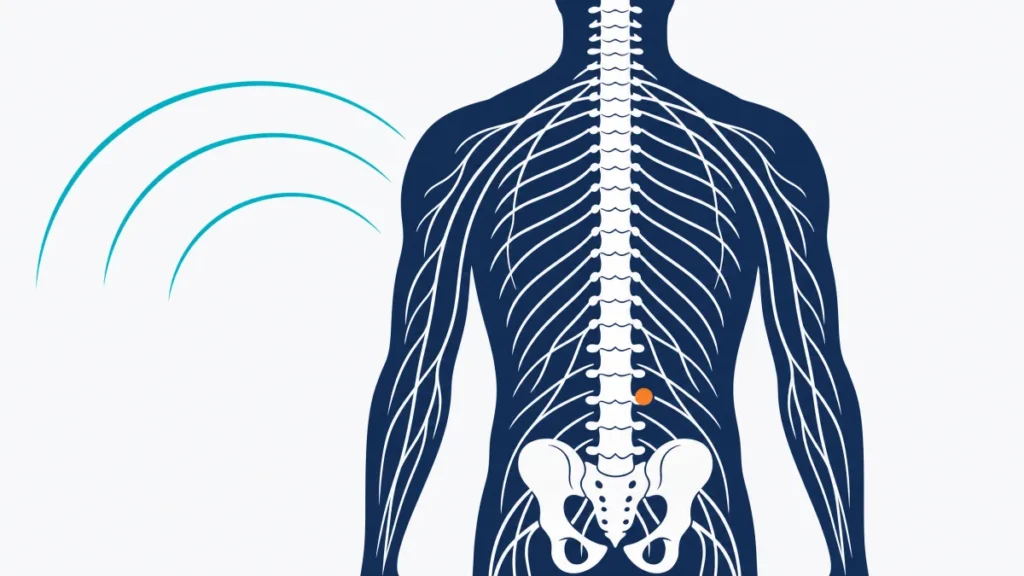
Peripheral nerves carry signals between the brain and spinal cord and the rest of the body. Peripheral neuropathy describes damage or dysfunction in those nerves. Diabetes is one possible cause. A peripheral nerve injury is a more specific event, such as a crush, cut, or surgical injury to a named nerve. These are related topics, but they are not the same research question. A symptom score in diabetic distal symmetric peripheral neuropathy does not measure regrowth after a severed nerve. Likewise, a rat nerve-injury experiment does not establish a result in people with diffuse neuropathy.
The PEMF literature includes sham-controlled trials in people with painful diabetic neuropathy, a recent systematic review of neuropathic-pain trials, and older experiments in rats with injured peripheral nerves. Researchers have measured pain ratings, quality-of-life questionnaires, skin perfusion pressure, nerve-fiber density, tissue findings, and animal movement measures. The studies differ in diagnosis, field characteristics, placement, comparison group, and follow-up. Those differences matter when interpreting a result.
This page concerns peripheral nerves outside the spine. It does not evaluate lumbar nerve-root compression or sciatica. That separate question is addressed in PEMF and sciatica.
The studies
Lara-Reyes et al. 2026 systematic review and meta-analysis
Lara-Reyes and colleagues reviewed 13 randomized controlled trials with 688 total participants that compared PEMF with sham in several forms of neuropathic pain. Their overall analysis initially favored PEMF for pain, but heterogeneity was extreme at I² = 92.8%. After their adjustment for potentially missing studies, the overall result was no longer statistically significant. Importantly for this page, the peripheral-neuropathy subgroup did not show a statistically significant difference from sham, with a standardized mean difference of -0.38 and a 95% confidence interval from -0.86 to 0.10.
This is the highest-level source in this group, but it combines varied diagnoses and devices. Its peripheral-neuropathy finding is a subgroup analysis, and the authors reported publication-bias concerns. It does not establish a uniform finding for diabetic neuropathy, traumatic nerve injury, or a particular device format.
Lara-Reyes JA, Zarate-Calderon C, Aranda-Abreu GE, García LI, Rojas-Durán F. “Effectiveness of Pulsed Electromagnetic Field Therapy on Neuropathic Pain: A Systematic Review and Meta-Analysis.” Neurology International. 2026;18(2):28. PMID: 41745713. DOI: 10.3390/neurolint18020028.
Tassone, Page, and Slepian 2025
This double-blind, randomized, sham-controlled trial enrolled 182 people with diabetes and painful distal symmetric peripheral neuropathy. The report compared active PEMF with a nonactive sham and collected daily pain scores. The authors reported a clinically significant 30% pain reduction from baseline relative to sham (P<.05) among active-arm participants who did not receive a low-field-strength notification caused by improper pad placement. Skin perfusion pressure in the active group showed a nonsignificant trend rather than a statistically significant difference.
The reported pain comparison was limited to a subset defined by a device-use notification, not plainly the entire randomized active group. The study also focused on painful diabetic distal symmetric neuropathy in the feet, not nerve transection, other causes of neuropathy, or nerve regeneration. Its results should therefore remain tied to that trial population and analysis.
Tassone EE, Page JC, Slepian MJ. “Assessing the Effects of Pulsed Electromagnetic Therapy on Painful Diabetic Distal Symmetric Peripheral Neuropathy: A Double-Blind Randomized Controlled Trial.” Journal of Diabetes Science and Technology. 2025;19(2):361-369. PMID: 37542366. DOI: 10.1177/19322968231190413.
Weintraub et al. 2009
Weintraub and colleagues conducted a randomized, double-blind, placebo-controlled trial in 225 people with stage II or III diabetic peripheral neuropathy. They compared PEMF and sham devices directed at the feet over three months. The active group had a more favorable patient global-impression result, 44% versus 31%, and the report described this as a trend favoring PEMF. However, the primary pain-intensity measures, the Neuropathy Pain Scale and visual analogue scale, did not differ significantly between active and sham groups.
A 27-person biopsy subset also had a between-group difference in the proportion with a prespecified increase in distal-leg epidermal nerve-fiber density. That biological measure was not the same as a demonstrated clinical regeneration outcome for the full trial population. Attrition was 13.8%, the biopsy subset was small, and the authors described the tested dosimetry as ineffective for pain intensity. These mixed findings are central to interpreting the study.
Weintraub MI, Herrmann DN, Smith AG, Backonja MM, Cole SP. “Pulsed Electromagnetic Fields to Reduce Diabetic Neuropathic Pain and Stimulate Neuronal Repair: A Randomized Controlled Trial.” Archives of Physical Medicine and Rehabilitation. 2009;90(7):1102-1109. PMID: 19577022. DOI: 10.1016/j.apmr.2009.01.019.
Wróbel et al. 2008
In this randomized sham-controlled study, 61 people with painful diabetic polyneuropathy were assigned to low-frequency pulsed magnetic-field exposure or sham exposure. Both groups reported lower pain scores over the study period. The between-group difference in pain reduction was not statistically significant. The groups also had similar changes in quality-of-life, sleep, and glycated hemoglobin measures.
This trial provides a clear null comparison, but it was small and short. The paper describes a low-frequency pulsed magnetic field, and its device characteristics should not be assumed to match those of other PEMF formats. Its outcome measures were symptom and questionnaire measures, not direct evidence of peripheral nerve regeneration.
Wróbel MP, Szymborska-Kajanek A, Wystrychowski G, Biniszkiewicz T, Siero?-Sto?tny K, Siero? A, Pierzcha?a K, Grzeszczak W, Strojek K. “Impact of Low Frequency Pulsed Magnetic Fields on Pain Intensity, Quality of Life and Sleep Disturbances in Patients with Painful Diabetic Polyneuropathy.” Diabetes & Metabolism. 2008;34(4 Pt 1):349-354. PMID: 18585071. DOI: 10.1016/j.diabet.2008.02.003.
Ito and Bassett 1983
Animal study. Ito and Bassett used a severed sciatic-nerve model in rats. The report compared PEMF exposure with controls and assessed how far regenerating axons entered the distal nerve stump, motor-force recovery after nerve stimulation, and tissue characteristics. The authors reported that regenerating axons extended nearly twice as far at two weeks in exposed animals and described earlier, higher motor-force recovery in the experimental group.
A surgically severed sciatic nerve in rats is a controlled injury model, not diabetic neuropathy or a human peripheral nerve injury. The experiment also cannot resolve how its whole-body exposure and animal outcome measures relate to a portable consumer format. It is mechanistically relevant animal evidence, not human clinical evidence.
Ito H, Bassett CA. “Effect of Weak, Pulsing Electromagnetic Fields on Neural Regeneration in the Rat.” Clinical Orthopaedics and Related Research. 1983;(181):283-290. PMID: 6641063.
Raji and Bowden 1983
Animal study. Raji and Bowden studied crush injuries and cut-and-sutured injuries of the common peroneal nerve in rats. They used standardized operative and histological methods and compared PEMF with sham exposure. The authors reported statistically significant differences in recovery of limb use and in several tissue measures after injury, including axonal regeneration and fibrosis. Healthy nerves were reported as unaffected.
The paper involved rat injuries and laboratory tissue measures. It did not enroll people with diabetic neuropathy or establish a result in human nerve-injury care. The injury types, exposure equipment, and outcomes also differ from the later human diabetic-neuropathy trials.
Raji AR, Bowden RE. “Effects of High-Peak Pulsed Electromagnetic Field on the Degeneration and Regeneration of the Common Peroneal Nerve in Rats.” The Journal of Bone and Joint Surgery. British Volume. 1983;65(4):478-492. PMID: 6603461. DOI: 10.1302/0301-620X.65B4.6603461.
Walker et al. 1994
Animal study. Walker and colleagues used rats with a crush lesion of the sciatic nerve and compared whole-body PEMF with sham exposure. They followed toe spread, gait-stance duration, and a footprint-derived sciatic function index through 43 days. The PEMF group had a statistically significant difference in toe spread. Gait-stance duration did not reach conventional statistical significance, and the sciatic function index showed no effect.
This study is useful because it reports both favorable and null outcome measures. It remains limited by the rat crush model, whole-body exposure, and animal functional tests. It does not determine what happens in people with peripheral neuropathy or whether a localized portable applicator has an equivalent research basis.
Walker JL, Evans JM, Resig P, Guarnieri S, Meade P, Sisken BS. “Enhancement of Functional Recovery Following a Crush Lesion to the Rat Sciatic Nerve by Exposure to Pulsed Electromagnetic Fields.” Experimental Neurology. 1994;125(2):302-305. PMID: 8313945. DOI: 10.1006/exnr.1994.1033.
How strong is this evidence?
The evidence specific to peripheral neuropathy and nerve injury is limited and mixed. The 2026 systematic review is informative because it gathered randomized sham-controlled trials, but its pooled estimate had extreme heterogeneity. Its overall statistical significance disappeared after a missing-study adjustment. Its peripheral-neuropathy subgroup was not statistically significant. Those results make a single summary estimate unreliable.
The human diabetic-neuropathy trials differ in size and findings. Wróbel et al. found improvements within both active and sham groups, with no significant between-group pain difference. Weintraub et al. found no significant difference in the main pain-intensity measures, while reporting a more favorable global-impression result and findings in a small biopsy subset. Tassone et al. reported a result in a subset without a low-field-strength notification, while the perfusion measure was nonsignificant. These are not interchangeable endpoints, and their differences are not resolved by treating each study as a replication of the others.
The animal literature concerns intentionally injured peripheral nerves. It helps researchers investigate biological mechanisms and functional measures after controlled crush or transection. Yet animal anatomy, injury timing, field delivery, and outcome tests differ from those in people with diabetic neuropathy. No animal finding establishes a human result. Across the full literature, small samples, attrition, short observation periods, varying device parameters, subgroup analyses, and possible publication bias all limit certainty.
What this means if you are considering a PEMF device
Start with the population and outcome in the citation, not a broad label such as “nerve damage.” A study of painful diabetic feet does not answer the same question as a study of a surgically injured nerve. A rat sciatic-nerve experiment addresses neither question directly. When a seller cites a study, ask which diagnosis, outcome, and comparison group it actually used.
A portable localized applicator for a specific peripheral area is a format that can be compared with research that placed a field over the feet or another peripheral area. Research formats vary in placement, field characteristics, exposure schedules, and whether the comparison was sham. This is a format comparison only. It is not evidence of equivalence or a recommendation. For general background, see what PEMF is and PEMF science.
Questions to ask before buying
- Does the seller provide the device’s waveform, frequency range, field-strength information, and applicator dimensions in writing?
- Can the seller identify the exact published study, diagnosis, outcome, and comparison group behind a research statement?
- Does the documentation distinguish a peripheral-neuropathy study from a peripheral nerve-injury experiment?
- Are placement, device format, and stated study parameters described clearly enough to compare formats without claiming they are equivalent?
- Are the return window, warranty terms, repair process, and contraindication information available before purchase?
This page summarizes published research for reference. It is not medical advice, and nothing here is a claim that any PEMF device treats, cures, or prevents any condition. PEMF is not appropriate for everyone — review PEMF contraindications and talk with your own physician before beginning any new therapy, particularly if you have an implanted electronic device, are pregnant, or are being treated for a serious medical condition.