
This page summarizes published research on pulsed electromagnetic fields (PEMF) in lumbar radiculopathy, radiating leg pain, low-back pain, and an animal sciatic-nerve model. It is for reference and does not state what any device will do for a person with sciatica.
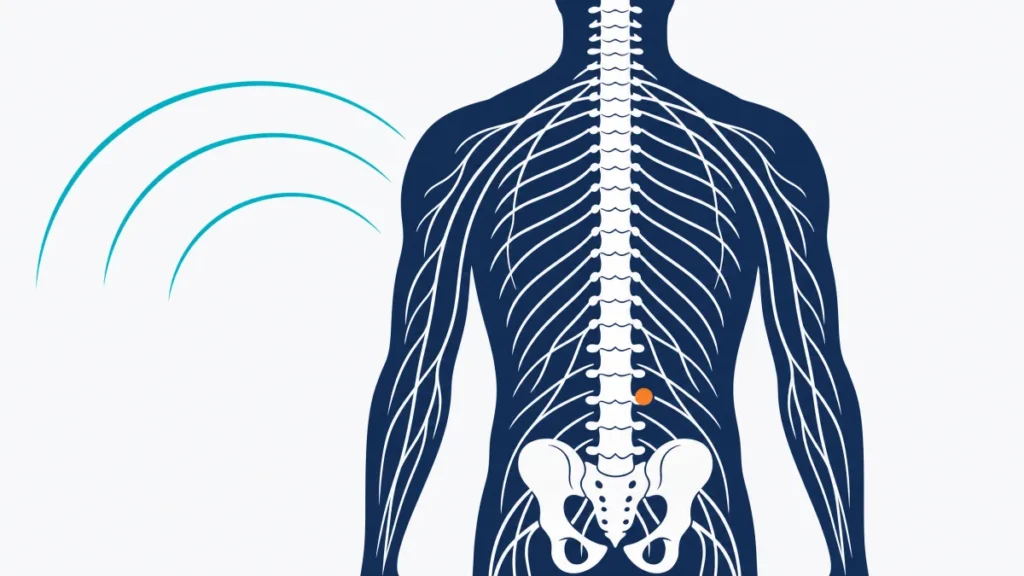
PEMF Sciatica: What researchers have studied
Sciatica is a symptom pattern, often pain that travels from the low back into a leg along a nerve-root distribution. It is not interchangeable with every kind of low-back pain. In this literature, discogenic lumbar radiculopathy, or nerve-root symptoms associated with a lumbar disc prolapse, is the closest human diagnosis. One small randomized trial studied that population directly. Another enrolled people with persistent low-back and/or radiating leg pain after lumbar surgery. Those populations are related to, but different from, uncomplicated sciatica.
Other randomized trials enrolled people with chronic non-specific low-back pain. They describe a broader low-back-pain literature but do not establish findings for radicular symptoms. The published record also includes a rat study involving a crushed sciatic nerve. That injury is not the same as human sciatica caused by disc-related nerve-root irritation or compression.
A 2026 systematic review and meta-analysis reported a spinal/radicular subgroup, but its global analysis was highly heterogeneous and changed after adjustment for possible missing studies. The record therefore includes some directly relevant human evidence, indirect low-back-pain evidence, and animal evidence. It does not include a consistent, replicated set of trials in people with clinically defined sciatica.
The studies
Lara-Reyes et al. 2026 systematic review and meta-analysis
Lara-Reyes and colleagues systematically reviewed 13 randomized trials with 688 participants that compared PEMF with sham for neuropathic pain. The global analysis was statistically significant but had extreme heterogeneity (I² = 92.8%). After a Trim-and-Fill adjustment for potentially missing studies, the global result was no longer statistically significant.
The spinal/radicular subgroup favored PEMF, while peripheral neuropathy did not show a statistically significant difference. This is the highest-level source here, but the radicular result is a subgroup result, not several matching sciatica trials. The authors emphasized heterogeneity and publication bias. The abstract does not say how many subgroup participants had disc-related sciatica or whether the findings apply to retail devices or individual readers.
Lara-Reyes JA, Zarate-Calderon C, Aranda-Abreu GE, García LI, Rojas-Durán F. “Effectiveness of Pulsed Electromagnetic Field Therapy on Neuropathic Pain: A Systematic Review and Meta-Analysis.” Neurology International. 2026;18(2):28. PMID: 41745713. DOI: 10.3390/neurolint18020028.
Omar, Awadalla, and El-Latif 2012
In this randomized trial, 40 people with disc-related lumbar radiculopathy were assigned to PEMF (n=20) or placebo (n=20). At baseline and after three weeks, the researchers assessed a visual analogue pain scale, Modified Oswestry disability questionnaire, and somatosensory evoked potentials.
The authors reported statistically significant between-group differences in pain, total disability, and the measured evoked-potential latency and amplitude. This diagnosis is more relevant to sciatica than the general low-back-pain studies below.
It was a single, small study with short follow-up, and the abstract does not report whether differences persisted. Its disc-prolapse population does not answer other causes of radiating leg symptoms. It cannot establish that its findings generalize to different PEMF waveforms, applicators, or retail devices.
Omar AS, Awadalla MA, El-Latif MA. “Evaluation of Pulsed Electromagnetic Field Therapy in the Management of Patients with Discogenic Lumbar Radiculopathy.” International Journal of Rheumatic Diseases. 2012;15(5):e101-e108. PMID: 23083041. DOI: 10.1111/j.1756-185X.2012.01745.x.
Sorrell et al. 2018
Sorrell et al. ran a multicenter, double-blind, randomized, sham-controlled pilot trial in 36 people with persistent low-back and/or radiating leg pain after lumbar surgery. Participants received one of two active pulse widths or sham. The primary measure was change in numeric ratings for low-back and leg pain.
Average leg-pain scores declined 45.0% in one active group, 17.0% in the other, and 24.5% with sham. Reported within-group p values were 0.009, 0.293, and 0.065. Several comparisons with sham, including responder proportion, time to a 30% score change, and patient global impression, had p values above 0.05.
This postoperative population differs from people with ordinary disc-related sciatica. The small pilot trial, two active configurations, and several nonsignificant sham comparisons limit interpretation. It is related evidence about radiating leg pain, not a direct sciatica study.
Sorrell RG, Muhlenfeld J, Moffett J, Stevens G, Kesten S. “Evaluation of Pulsed Electromagnetic Field Therapy for the Treatment of Chronic Postoperative Pain Following Lumbar Surgery: A Pilot, Double-Blind, Randomized, Sham-Controlled Clinical Trial.” Journal of Pain Research. 2018;11:1209-1222. PMID: 29950893. DOI: 10.2147/JPR.S164303.
Alzayed and Alsaadi 2020
This double-blind randomized trial assigned 42 people with chronic low-back pain to PEMF plus therapeutic exercises or sham plus the same exercises. Pain and Roland-Morris disability were measured through week 13.
The authors reported faster improvement in the active group at week 3. At weeks 6 and 13, they reported no between-group difference in pain or disability.
The participants were not selected for sciatica or radiculopathy, and both groups exercised. The small sample and 13-week observation further limit generalizability.
Alzayed KA, Alsaadi SM. “Efficacy of Pulsed Low-Frequency Magnetic Field Therapy on Patients with Chronic Low Back Pain: A Randomized Double-Blind Placebo-Controlled Trial.” Asian Spine Journal. 2020;14(1):33-42. PMID: 31575112. DOI: 10.31616/asj.2019.0043.
Lisi et al. 2019
Lisi and colleagues ran a randomized, double-blind, sham-controlled pilot trial of a portable PEMF device alongside usual care for mixed-duration, non-specific low-back pain. Forty-two participants were randomized, and 25 completed the study. Functional capacity was measured with the Oswestry Disability Index at baseline, six weeks, and 12 weeks.
The authors reported a statistically significant baseline-to-week-6 change in Oswestry scores within the active group, while the reported change within the sham group was not statistically significant. They reported that this pattern persisted at week 12.
Attrition was substantial, and the diagnosis was non-specific low-back pain. Results from a portable device in that setting are format-relevant only in a limited sense. They do not establish findings for radicular symptoms, disc prolapse, postoperative radiating pain, or other causes of sciatica.
Lisi AJ, Scheinowitz M, Saporito R, Onorato A. “A Pulsed Electromagnetic Field Therapy Device for Non-Specific Low Back Pain: A Pilot Randomized Controlled Trial.” Pain and Therapy. 2019;8(1):133-140. PMID: 30868475. DOI: 10.1007/s40122-019-0119-z.
Walker et al. 1994
This is an animal study, and it is the citation preserved from the previous version of this page. Walker and colleagues used rats with a crush lesion to the sciatic nerve and compared whole-body PEMF exposure with sham. They followed toe spread, gait-stance duration, and a sciatic function index derived from footprints through day 43.
The researchers reported better results in the PEMF group on video-measured toe spread. Gait-stance duration had a p value of 0.081, which was not statistically significant by the conventional 0.05 threshold. They reported no effect on the sciatic function index.
A crushed peripheral nerve in rats is not lumbar nerve-root symptoms in people. The whole-body exposure and animal functional measures create a major condition and format mismatch. This study cannot determine whether the findings apply to human sciatica or a consumer PEMF device.
Walker JL, Evans JM, Resig P, Guarnieri S, Meade P, Sisken BS. “Enhancement of Functional Recovery Following a Crush Lesion to the Rat Sciatic Nerve by Exposure to Pulsed Electromagnetic Fields.” Experimental Neurology. 1994;125(2):302-305. PMID: 8313945. DOI: 10.1006/exnr.1994.1033.
How strong is this evidence?
The evidence specific to sciatica is limited. Omar et al. is the clearest direct human trial because it enrolled people with discogenic lumbar radiculopathy. It had 40 participants, short follow-up, and no replication identified here. The systematic review adds a spinal/radicular subgroup, but its overall analysis had extreme heterogeneity and lost statistical significance after an adjustment for possible missing studies. A subgroup finding is not equivalent to several consistent trials in people with the same diagnosis.
The other human studies are informative but indirect. Sorrell et al. enrolled people with persistent pain after lumbar surgery, a population different from ordinary disc-related sciatica. Alzayed and Alsaadi, and Lisi et al., studied non-specific low-back pain rather than radicular symptoms. In Alzayed and Alsaadi, the early between-group difference was not present at weeks 6 and 13. In Sorrell et al., several comparisons with sham were not statistically significant. Those results make the literature mixed rather than uniform.
The studies used different devices, output characteristics, comparators, co-interventions, outcomes, and observation periods. Small samples and dropout reduce precision. The rat study is mechanistically adjacent because it involved the sciatic nerve, but its injury model and whole-body exposure limit generalizability. This record supports careful description of named studies. It does not support a broad conclusion about what any device will do for a person with sciatica.
What this means if you are considering a PEMF device
The research most relevant to radiating leg symptoms used clinical-study equipment in narrow diagnoses. Device format is a separate question from condition evidence. For a localized lower-back or leg area, a portable applicator is the format most closely related to the placement concept in portable-device research, rather than a full-body mat. That observation does not make the studies applicable to a particular device, product, diagnosis, or person.
Distinguish radicular symptoms from general low-back pain when comparing research summaries. Radicular symptoms are associated with a nerve root and can include pain that travels into a leg. Non-specific low-back-pain trials may not identify a disc prolapse, prior surgery, or another source of symptoms. Ask sellers to distinguish what a study enrolled from what their product description says. For equipment context, see portable PEMF machines and PEMF mats compared with PEMF machines.
Questions to ask before buying
- Does the seller provide the waveform, frequency range, field-strength information, and applicator dimensions in writing?
- Does the manual identify what comes with the unit, including applicators, power supply, controls, and carrying options?
- Can the seller identify the exact study population behind a research summary and distinguish radicular symptoms from non-specific low-back pain?
- What are the written return window, warranty terms, repair process, and any restocking fees?
- Are the device’s intended general-wellness positioning and its limitations described clearly without condition claims?
- Is the product documentation, including contraindication information, available before purchase?
This page summarizes published research for reference. It is not medical advice, and nothing here is a claim that any PEMF device treats, cures, or prevents any condition. PEMF is not appropriate for everyone — review PEMF contraindications and talk with your own physician before beginning any new therapy, particularly if you have an implanted electronic device, are pregnant, or are being treated for a serious medical condition.