
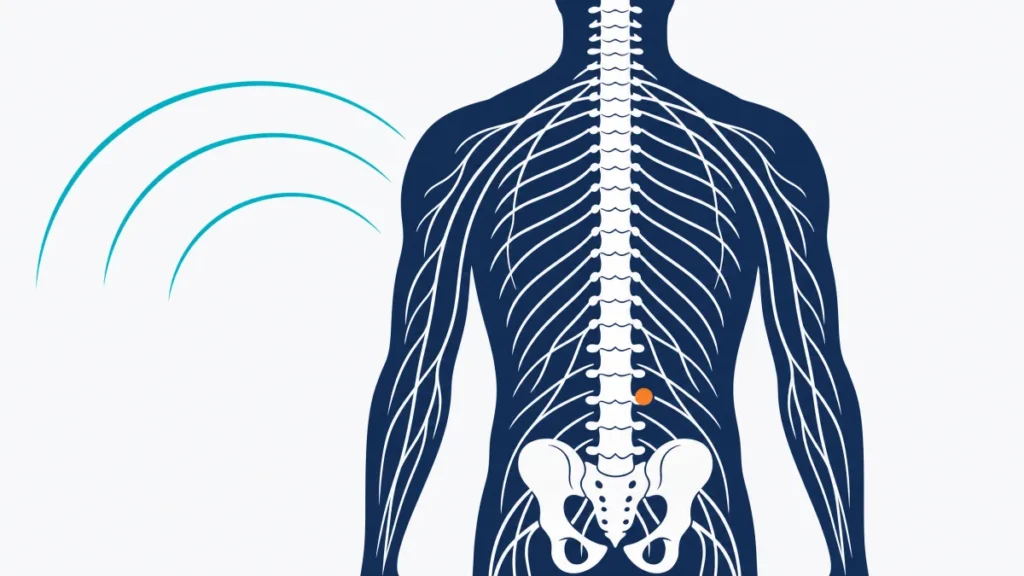
This page examines pulsed electromagnetic field (PEMF) research in non-specific low back pain: back pain without an identified structural cause, leg radiation, or a confirmed disc lesion. Pain with leg radiation and a confirmed disc lesion are different clinical questions; see sciatica and herniated disk research instead. The studies report group results, not personal outcomes.
What researchers have studied
Non-specific low back pain is used when a recognized cause such as fracture, infection, inflammatory disease, radicular syndrome, or a structural disc problem has not been identified. It is not a label for every low-back ache. That distinction matters because PEMF research has often grouped discogenic radiculopathy, postsurgical pain, and pain without an identified structural source under “low back pain.”
The most directly relevant research uses pain ratings and disability questionnaires, including the Oswestry Disability Index and Roland-Morris Disability Questionnaire. It does not establish a shared device design, session schedule, or outcome measure. Some studies used a sham field; others added PEMF to exercise, conventional physical therapy, or osteopathic manipulation. Those differences limit comparisons across device formats and settings.
The evidence summary below excludes animal studies and does not use trials of confirmed disc lesions or radiating leg pain as direct evidence for non-specific low back pain.
The studies
Kull et al. systematic review, online 2023 and print 2025
Kull and colleagues conducted a systematic review restricted to randomized controlled trials in non-specific low back pain that measured both pain and physical function. The review included nine trials with 420 participants. Five trials reported statistically significant differences favoring the PEMF group for pain and physical function, while the remaining record was not uniformly positive. The review is particularly useful for this page because its stated inclusion criteria excluded trials in which a specific reason for low back pain had not been excluded.
The authors found substantial variation in session length, number of treatments, frequency, intensity, comparison groups, and accompanying care. Sessions ranged from 10 to 30 minutes, schedules from two to seven sessions a week, frequencies from 3 to 50 Hz, and reported intensities from 2 to 150 mT. This narrative review cannot identify one format or protocol for all non-specific low back pain.
Kull P, Keilani M, Remer F, Crevenna R. “Efficacy of Pulsed Electromagnetic Field Therapy on Pain and Physical Function in Patients with Non-Specific Low Back Pain: A Systematic Review.” Wiener Medizinische Wochenschrift. 2025;175(1-2):11-19. Epub 2023 Nov 24. PMID: 37999784. DOI: 10.1007/s10354-023-01025-5.
Andrade et al. 2016 systematic review
Andrade and colleagues reviewed six randomized studies qualitatively and five quantitatively, covering 210 participants. Their conclusion described a tendency toward lower pain scores and better function. It is one of the earlier reviews that reported a favorable functional interpretation, but its population was broad. The included studies covered generalized low back pain, acute non-specific pain, chronic low back pain, discogenic lumbar radiculopathy, and failed-back-surgery pain.
That mixed scope is a central limitation for a page about non-specific pain without leg radiation or a confirmed lesion. Functional measures and protocols varied. The review provides historical context but not condition-matched evidence for the narrow population defined here.
Andrade R, Duarte H, Pereira R, Lopes I, Pereira H, Rocha R, Espregueira-Mendes J. “Pulsed Electromagnetic Field Therapy Effectiveness in Low Back Pain: A Systematic Review of Randomized Controlled Trials.” Porto Biomedical Journal. 2016;1(5):156-163. PMID: 32258569. DOI: 10.1016/j.pbj.2016.09.001.
Sun et al. 2022 systematic review and meta-analysis
Sun and colleagues pooled 14 randomized trials with 618 participants who had low back pain. They reported lower pain scores for PEMF than placebo or other therapy alone in their pooled analyses. For physical function, however, the pooled result was not statistically significant: standardized mean difference -0.45, 95% confidence interval -0.98 to 0.07, with high heterogeneity (I² = 86%). Their acute-low-back-pain subgroup also did not show a statistically significant difference for pain.
This is the earlier review that disagreed with Andrade et al. on physical function. It addressed low back pain generally rather than an exclusively non-specific, no-leg-radiation population. Its null functional result shows that a favorable pain result in a mixed record does not automatically translate into a consistent disability result.
Sun X, Huang L, Wang L, Fu C, Zhang Q, Cheng H, Pei G, Wang Y, He C, Wei Q. “Efficacy of Pulsed Electromagnetic Field on Pain and Physical Function in Patients with Low Back Pain: A Systematic Review and Meta-Analysis.” Clinical Rehabilitation. 2022;36(5):636-649. PMID: 35077249. DOI: 10.1177/02692155221074052.
Lisi et al. 2019 portable-device pilot trial
Lisi and colleagues ran a randomized, double-blind, sham-controlled pilot trial in people with mixed-duration non-specific low back pain. Forty-two participants were randomized to usual care plus a portable PEMF device or usual care plus sham, and 25 completed the study. The primary outcome was the Oswestry Disability Index at baseline, six weeks, and 12 weeks. The authors reported a statistically significant baseline-to-week-six change in the active group, while the corresponding within-group sham result was not statistically significant; they reported that the pattern persisted at 12 weeks.
This is a directly relevant human trial because it enrolled non-specific low back pain and used a portable device. Attrition was substantial, the sample was small, participants also received usual care, and use was self-directed. These features limit what can be inferred about another portable unit, a mat, or an individual experience.
Lisi AJ, Scheinowitz M, Saporito R, Onorato A. “A Pulsed Electromagnetic Field Therapy Device for Non-Specific Low Back Pain: A Pilot Randomized Controlled Trial.” Pain and Therapy. 2019;8(1):133-140. PMID: 30868475. DOI: 10.1007/s40122-019-0119-z.
Alzayed and Alsaadi 2020 randomized trial
Alzayed and Alsaadi enrolled 52 participants with chronic low back pain and analyzed 42 after 10 did not complete the study. Participants received PEMF plus therapeutic exercise or sham PEMF plus the same exercise program. The active group had earlier within-group improvement in pain and Roland-Morris disability at week 3. By weeks 6 and 13, the investigators reported no between-group difference in pain or disability. The active intervention used a BEMER Pro Set with a full-body mattress applicator for 20 minutes under technician administration.
This sham-controlled trial is mixed-population evidence, not direct evidence for this page’s scope. Eligibility allowed participants with or without leg pain. That population difference, the shared exercise program, and the clinic-based full-body format limit comparison with portable-device or strictly non-specific trials.
Alzayed KA, Alsaadi SM. “Efficacy of Pulsed Low-Frequency Magnetic Field Therapy on Patients with Chronic Low Back Pain: A Randomized Double-Blind Placebo-Controlled Trial.” Asian Spine Journal. 2020;14(1):33-42. PMID: 31575112. DOI: 10.31616/asj.2019.0043.
How strong is this evidence?
The evidence is limited, mixed, and sensitive to scope. Kull et al. is the closest review to the condition defined on this page because it selected non-specific low back pain trials and found nine randomized trials with 420 participants. Yet only five of those trials reported significant pain and function differences, and its table also includes trials with no significant between-group differences. Its wide range of frequencies, field intensities, treatment schedules, co-interventions, and outcome tools prevents the studies from functioning as one interchangeable test of “PEMF.”
The disagreement on physical function should not be resolved in favor of the technology. Andrade et al. described better functionality, but its small review combined non-specific pain with discogenic radiculopathy and failed-back-surgery pain. Sun et al. included a broader low-back-pain record and found no statistically significant functional advantage, with high heterogeneity for that outcome. The reviews also used different search dates, trial sets, analytic methods, and disability measures. Oswestry, Roland-Morris, functional-activity, and other scores are related, but they are not the same measurement.
The human trials add positive, negative, and mixed findings. Lisi et al. reported a promising pattern in a small portable-device pilot with substantial dropout. Alzayed and Alsaadi reported an earlier difference but no between-group difference later. Studies with radicular or postoperative populations add uncertainty because they differ from non-specific low back pain. The record does not support a uniform conclusion about device format, dose, or personal outcome.
What this means if you are considering a PEMF device
Start with the study setting rather than the broad label “low back pain.” The portable trial used a self-directed portable device alongside usual care. The 2020 trial used a clinic-administered BEMER system with a full-body mattress applicator, plus therapeutic exercise. The trials summarized by Kull et al. used scheduled sessions with varied study equipment and comparison groups. Many reports therefore describe clinic equipment or supervised sessions rather than a consumer home mat.
A device category is not a substitute for the studied intervention. A portable applicator, full-body mat, and clinic system can differ in placement, controls, output information, and how use is supervised. The evidence does not establish that one format is equivalent to another, or that a schedule from one trial transfers to another device. When reading a seller’s research summary, check whether the cited population had non-specific pain without leg radiation, whether the study used a sham comparison, and whether the endpoint was pain, disability, or both. That is a more useful comparison than a general claim about low back pain.
Back pain accompanied by fever, unexplained weight loss, bowel or bladder changes, or progressive leg weakness needs prompt medical assessment, not a device.
Questions to ask before buying
- Can the seller provide the complete study citation and identify whether participants had non-specific low back pain without leg radiation, rather than radiculopathy, surgery-related pain, or a confirmed disc lesion?
- What device format and applicator were used in the cited study, and does the seller clearly distinguish that study equipment from the item being sold?
- Are the waveform description, frequency range, field-strength information, session controls, and applicator dimensions available in writing?
- What are the written return window, restocking terms, warranty length, repair process, and replacement-part policy?
- Does the documentation state the product’s intended-use language and limitations plainly, without converting a study result into a personal-outcome promise?
This page summarizes published research for reference. It is not medical advice, and nothing here is a claim that any PEMF device treats, cures, or prevents any condition. PEMF is not appropriate for everyone — review PEMF contraindications and talk with your own physician before beginning any new therapy, particularly if you have an implanted electronic device, are pregnant, or are being treated for a serious medical condition.