
This page summarizes published research on pulsed electromagnetic fields (PEMF) in disc herniation, intervertebral-disc degeneration, and spinal-fusion contexts. It is for reference and does not state what any device will do for a reader with a disc-related condition.
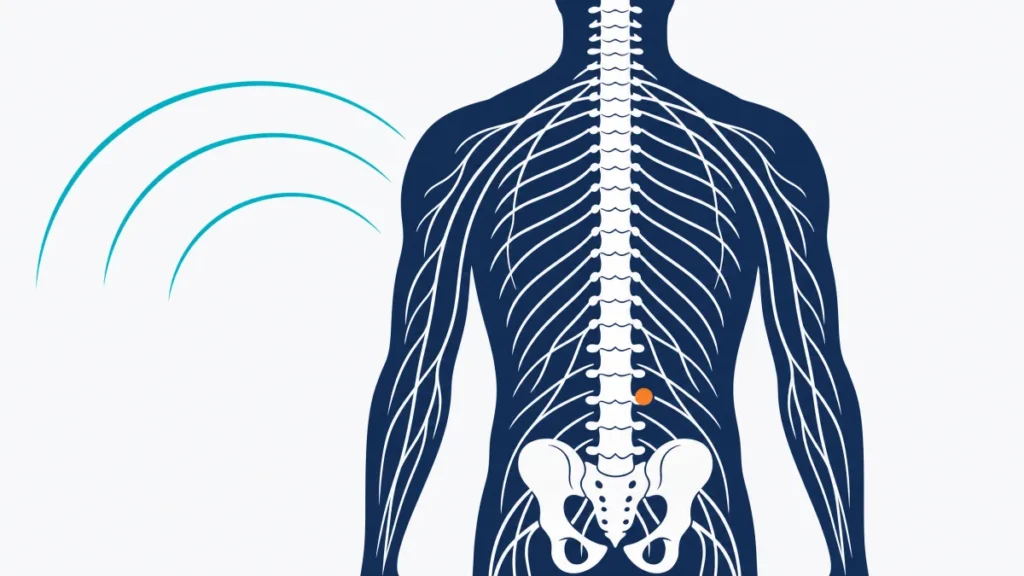
PEMF Herniated Discs: What researchers have studied
A herniated disc is a structural finding in which disc material extends beyond its usual boundary. Disc degeneration describes changes in disc tissue over time. These are different research questions from whether a person has radiating leg pain. Radiating leg pain and lumbar radiculopathy are addressed on the published sciatica page, rather than repeated here.
The studies below examine several distinct settings. One randomized trial enrolled people with cervical disc herniation and compared PEMF added to other physical modalities with a sham field added to the same modalities. Two postoperative studies examined lumbar fusion, where radiographic fusion is different from the status of a herniated disc itself. The preclinical studies used puncture or needle-stab injury models in rats, not naturally occurring human disc disease. A recent systematic review brought these cell, animal, and clinical records together.
This distinction matters when reading a result. A change in a symptom questionnaire is not imaging evidence of a change in disc structure. An MRI or histology finding in rats is not a result in people. Similarly, a postoperative fusion study does not answer whether a non-surgical herniated disc changes. The record contains relevant signals, but the populations, comparators, outcomes, and field parameters vary substantially.
The studies
Veronesi et al. 2026 systematic review
Veronesi and colleagues reviewed published preclinical and clinical evidence on PEMF and intervertebral-disc degeneration. Their PRISMA-based search covered 2000 through 2025 and included 16 studies: seven in vitro studies, four in vivo studies, four clinical randomized controlled trials, and one combined study. The review reported that the experimental record included disc-structure, inflammation, and cell-level outcomes, while the clinical trials mainly reported pain, function, or mobility outcomes.
The authors described clinical findings as inconsistent and noted common methodological limitations. Their review therefore offers a map of the literature rather than a pooled estimate for one diagnosis, device, or structural endpoint. It also combined cell experiments, animal models, and varied human populations. The review does not establish whether a structural result in a laboratory or animal model corresponds to imaging or surgical outcomes for an individual with a herniated disc.
Veronesi F, Salamanna F, Martini L, Contartese D, Ghermandi R, Marchese L, Gasbarrini A, Giavaresi G. “Impact of Pulsed Electromagnetic Fields on Intervertebral Disc Degeneration: A Systematic Review of Preclinical and Clinical Evidence.” Frontiers in Aging. 2026;7:1840672. PMID: 42238537. DOI: 10.3389/fragi.2026.1840672.
Hattapo?lu et al. 2019 cervical disc-herniation trial
Hattapo?lu and colleagues conducted a prospective, double-blind randomized trial in 74 people with cervical disc herniation. Participants received either PEMF plus transcutaneous electrical nerve stimulation and hot packs, or a sham magnetic field plus the same transcutaneous electrical nerve stimulation and hot packs. Sixty-four participants completed the follow-up. The investigators measured neck-pain ratings, a neck disability scale, mood questionnaires, and quality-of-life measures at baseline, week 3, and week 12.
Both groups improved from baseline. At week 12, the authors reported a statistically significant difference in the change in pain ratings and one sleep subdomain, but not in the neck disability score. This is a direct human disc-herniation study, yet it did not report imaging evidence that the herniation itself changed. The combined care, dropout, single cervical population, and lack of a separate PEMF-only group make it difficult to isolate the role of the field or extend the findings to lumbar disc problems.
Hattapo?lu E, Batmaz ?, Dilek B, Karakoç M, Em S, Çevik R. “Efficiency of Pulsed Electromagnetic Fields on Pain, Disability, Anxiety, Depression, and Quality of Life in Patients with Cervical Disc Herniation: A Randomized Controlled Study.” Turkish Journal of Medical Sciences. 2019;49(4):1095-1101. PMID: 31385489. DOI: 10.3906/sag-1901-65.
Mooney 1990 lumbar interbody-fusion trial
Mooney reported a randomized, double-blind prospective trial in 195 people undergoing lumbar interbody fusion. Ninety-eight participants used a brace containing active electromagnetic-field equipment and 97 used a sham brace. The abstract reports a 92% fusion success rate in the active group and a 65% rate in the control group. This is a structural postoperative outcome because fusion status, not a symptom score alone, was the stated endpoint.
The study concerns bone fusion after surgery, not the disc material or disc height in a herniated disc. The record is also more than three decades old, and the abstract provides limited detail about imaging criteria, losses to follow-up, and whether results varied by surgical technique or participant characteristics. It should not be read as imaging evidence about non-surgical disc herniation.
Mooney V. “A Randomized Double-Blind Prospective Study of the Efficacy of Pulsed Electromagnetic Fields for Interbody Lumbar Fusions.” Spine (Phila Pa 1976). 1990;15(7):708-712. PMID: 2218718. DOI: 10.1097/00007632-199007000-00016.
Weinstein et al. 2023 lumbar-fusion cohort
Weinstein and colleagues conducted a prospective, multicenter study of 142 people receiving PEMF as an adjunct after lumbar spinal fusion. Enrolled participants had at least one risk factor for pseudarthrosis, such as prior failed fusion, multilevel fusion, nicotine use, osteoporosis, or diabetes. At 12 months, radiographic assessment classified 125 of 142 participants, or 88.0%, as having successful fusion. The authors also reported better participant-reported scores than baseline.
There was no untreated or sham comparison group, so the study cannot separate the observed postoperative course from the contribution of the study intervention, surgery, or other care. The paper reports financial support from, and participation by, the device company in study design, analysis, interpretation, and writing. Its radiographic endpoint makes it relevant to postoperative fusion context, but it does not test disc-herniation structure or provide a direct comparison for a reader considering a device.
Weinstein MA, Beaumont A, Campbell P, Hassanzadeh H, Patel V, Vokshoor A, Wind J, Radcliff K, Aleem I, Coric D. “Pulsed Electromagnetic Field Stimulation in Lumbar Spine Fusion for Patients With Risk Factors for Pseudarthrosis.” International Journal of Spine Surgery. 2023;17(6):816-823. PMID: 37884337. DOI: 10.14444/8549.
Zheng et al. 2022 rat disc-degeneration experiment
This animal study combined experiments in human degenerated nucleus-pulposus cells with a rat-tail puncture model of intervertebral-disc degeneration. After eight weeks, the authors assessed rat discs with MRI, a Pfirrmann score, histology, collagen staining, and tissue markers. Compared with the puncture-only group, the exposed rat group had differences in the reported MRI score, histological score, collagen findings, and selected tissue markers.
The structural measures make this study pertinent to the question of how researchers have tested disc degeneration. However, a punctured tail disc in rats is not a cervical or lumbar herniated disc in people. The study did not assess human imaging outcomes, surgical results, or long-term clinical function. Its cell findings are mechanistic observations, not a clinical result.
Zheng Y, Mei L, Li S, Ma T, Xia B, Hao Y, Gao X, Wei B, Wei Y, Jing D, Luo Z, Huang J. “Pulsed Electromagnetic Field Alleviates Intervertebral Disc Degeneration by Activating Sirt1-Autophagy Signaling Network.” Frontiers in Bioengineering and Biotechnology. 2022;10:853872. PMID: 35387300. DOI: 10.3389/fbioe.2022.853872.
Chan et al. 2019 rat-tail injury experiment
This animal study used 72 rats with needle-stab injury to tail intervertebral discs. The researchers assigned animals to sham control, needle stab, or needle stab plus PEMF. They measured inflammatory cytokines, anabolic and catabolic gene expression, protein levels, and histologic changes after four or seven days. At day 7, the authors reported lower levels of several injury-associated inflammatory cytokines in the exposed injury group than in the stab-only group.
The structural finding was mixed. The authors reported that they did not observe a consistent effect on acute histologic change or on anabolic and catabolic factor expression. The short observation period, tail-disc injury model, and animal endpoints limit relevance to a human herniation, imaging finding, or postoperative course. This null structural result is important because biochemical differences alone did not align with a consistent early histology difference.
Chan AK, Tang X, Mummaneni NV, Coughlin D, Liebenberg E, Ouyang A, Dudli S, Lauricella M, Zhang N, Waldorff EI, Ryaby JT, Lotz JC. “Pulsed Electromagnetic Fields Reduce Acute Inflammation in the Injured Rat-Tail Intervertebral Disc.” JOR Spine. 2019;2(4):e1069. PMID: 31891118. DOI: 10.1002/jsp2.1069.
How strong is this evidence?
The evidence is limited and mixed for disc-related structural questions. The systematic review found a small and varied body of work. It included laboratory studies, animal models, and clinical trials with different diagnoses, so a shared conclusion about disc structure in people is not available. Its clinical studies largely tracked symptoms and function rather than serial MRI, disc height, herniation size, or repeat surgery.
The human cervical-disc trial was randomized and double-blinded, but both groups received other physical modalities. Both groups improved, and the disability outcome did not show a between-group difference. It also studied cervical rather than lumbar discs and did not report structural imaging change. The lumbar-fusion trial had a sham comparison and a structural endpoint, but fusion after surgery is a different process from a herniated disc. The newer lumbar-fusion cohort lacked a comparator and reported industry involvement in design, analysis, interpretation, and manuscript preparation.
The two rat studies provide the most direct imaging or tissue-level disc observations in this group of studies, but animal disc injury models do not reproduce the full biology, anatomy, care setting, or outcomes of human herniation. One found MRI and histology differences after a longer observation period, while the other found no consistent short-term histology effect. Across the record, field characteristics, exposure schedules, follow-up periods, comparators, and outcome definitions differ. Small samples, attrition, co-interventions, and incomplete replication further limit certainty. This is evidence to describe carefully, not a basis for a broad personal-outcome conclusion.
What this means if you are considering a PEMF device
Start by matching a claim to the study’s actual setting. A study of cervical disc symptoms is not a study of lumbar imaging. A postoperative fusion study is not a study of a non-surgical herniation. A rat MRI or histology result is not a human outcome. When a seller cites research, ask whether the cited endpoint was a symptom score, radiographic fusion, MRI, histology, or something else.
A portable applicator for a localized lower-back area is a format comparison only, not evidence of equivalence or a recommendation. The studies used specific equipment, configurations, and care settings. Those details do not establish that another applicator, mat, or device has the same characteristics or would produce the study findings. Written specifications, the full study citation, and clear return and warranty terms are practical information to compare before making a purchase.
Questions to ask before buying
- Does the seller provide the exact study citation and explain whether it involved disc imaging, postoperative fusion, symptoms, or an animal model?
- Is the device’s waveform, frequency range, field-strength information, and applicator size available in writing?
- Does the documentation distinguish research equipment from the device being sold, rather than implying that they are equivalent?
- What are the written warranty, return window, restocking fee, repair process, and replacement-part terms?
- Are intended-use language, limitations, and contraindication information available before purchase?
This page summarizes published research for reference. It is not medical advice, and nothing here is a claim that any PEMF device treats, cures, or prevents any condition. PEMF is not appropriate for everyone — review PEMF contraindications and talk with your own physician before beginning any new therapy, particularly if you have an implanted electronic device, are pregnant, or are being treated for a serious medical condition.